
The 30-Second Scene From Akira That Hollywood Still Cannot Stop Copying
Kaneda's motorcycle slide was animated before the rest of Akira existed — a 30-second proof of concept built to secure funding, and the most copied sequence in animation history nearly four decades later.
Does any single, thirty-second sequence in animation history hold more sway over filmmakers than Kaneda’s iconic motorcycle slide from Akira? Thirty-eight years after a half-minute teaser first leaked, Western directors still turn to it as the ultimate benchmark for animated mastery. This isn’t just a fleeting reference; it’s a foundational text, a visual blueprint for conveying power, control, and an undeniable sense of arrival.
In 1987, a year before Akira premiered, someone in Japan made a bold decision: animate an entire scene before the rest of the film even existed. This was a technical choice that yielded historical results. The most famous sequence from the film. Kaneda’s motorcycle roaring into view, braking sideways, the bike sliding in a perfect arc before coming to a halt. It did not follow the chronological order of production. It was the very first piece completed, crafted with deliberate intent ahead of everything else.
The motivation behind this unusual approach was purely practical. Akira commanded an astronomical budget for an anime in 1988, roughly ¥700 million, which translated to about $5.5 million at the time. To secure funding, to sell the ambitious project to the industry, and to convince distributors of its unparalleled vision, director Katsuhiro Otomo needed more than just storyboards or concept art. He needed a finished scene, a tangible demonstration of the technical standard he envisioned for the entire film. This was a critical Japan-first insight: rather than relying on traditional pitch materials, Otomo pushed for a fully animated proof-of-concept, a move that defied conventional anime production pipelines where animation often followed voice recording and was completed in sequence.
The chosen scene, naturally, was the motorcycle slide. Hitoshi Ueda received the task of drawing it, while Koji Morimoto, a veteran animator who would go on to train half the Japanese industry in subsequent decades, provided corrections and refinements. Between 1986 and 1987, these two artists meticulously worked to perfect thirty seconds of animation, long before the sprawling narrative of Neo-Tokyo took its final form.
When the teaser finally emerged in 1987, it quickly circulated beyond Japan’s borders, preceding the film’s official release. American animators saw it. European directors saw it. People who had never watched anime on tape or in theaters witnessed that motorcycle slide and immediately recognized something entirely new, something nobody had ever achieved before. The full film would not premiere until July 1988, but the scene itself already had a year of life, spreading through industry word-of-mouth, sparking conversations and inspiring awe.
This specific detail fundamentally alters how we understand Akira’s legacy. The film did not become a cult classic after its completion. It achieved cult status while still in production, with the motorcycle scene serving as its undeniable entry point. The rest of the film, in a sense, found itself compelled to meet the impossibly high technical standard set by those initial thirty seconds. Otomo spent the subsequent two years chasing the very benchmark his own teaser had established.
Why the Bike Slowed Down That Way
To truly grasp why this scene continues to serve as a reference point nearly four decades later, one must understand the prevailing standards of anime production in 1988. At that time, animators created anime using cels: transparent acetate sheets. Each cel was painstakingly drawn by hand, painted by hand, and then photographed once. To conserve both time and money, most anime productions employed a technique known as “limited animation.” This method involved photographing the same cel two or three times in succession, resulting in a motion rate of 12 or even 8 frames per second, rather than the 24 frames per second typically required for standard cinematic fluidity. The outcome was animation that often appeared visibly truncated: mouths moved only during speech, character bodies remained largely static, and backgrounds frequently reused.
Akira took the opposite approach. Otomo made the radical decision to animate significant portions of the film at a true 24 frames per second. This meant each frame required a new cel, and each cel featured a distinct drawing. The entire production ultimately amassed over 160,000 cels: a staggering two to three times the number typically used for a feature-length animated film of that era.
In the motorcycle scene, this commitment to full animation translates into an extraordinary level of detail. The bike does not merely “stop”; it decelerates with a physics-defying yet entirely believable verisimilitude. The wheels continue to spin even as the motorcycle slides sideways, conveying the friction and momentum. Kaneda’s weight shifts, tilting the vehicle at precisely the correct angle, a subtle yet crucial detail that grounds the action in reality. Electric sparks erupt from the friction between the metallic structure and the asphalt, and each individual spark follows its own unique trajectory, there are no loops, no repetitions; every single spark is drawn individually, a fleeting burst of light and energy. The smoke billowing from the friction rises in a logical direction, dispersing naturally as the air reacts to the vehicle’s speed and the surrounding environment.
Yet, the detail that truly distinguishes Akira from everything that preceded it lies in the movement of its shadows. The nocturnal street lighting strikes the motorcycle from different angles in every single frame as its position changes. In standard 1988 animation, shadows remained fixed, drawn once and then held in place. In Akira, every cel features recalculated shadows, dynamically responding to the shifting light sources. The motorcycle itself reflects the ambient glow of the neon signs in the background. Those background neons, in turn, are individually animated, each window possessing its own subtle flicker and pulse, creating a living, breathing cityscape.
These thirty seconds of animation contain the technical equivalent of fifteen minutes of an average anime from the same decade. Hitoshi Ueda and Koji Morimoto delivered a piece of work that, had the entire industry attempted to maintain such a standard, would have bankrupted every studio in Japan due to exorbitant costs. It stood as an exception, not a rule. But it was an exception so potent, so visually arresting, that it fundamentally recalibrated the measuring stick for everyone who followed. It demonstrated what was possible when artistic vision met an uncompromising commitment to craft, pushing the boundaries of what animation could achieve.
The Budget Nobody Dared to Spend
For this singular scene to exist, someone had to authorize spending double the average budget for an animated feature. More than that, they had to place immense trust in a first-time director. Katsuhiro Otomo was not a film director before Akira; he was a mangaka, a manga artist. His Akira manga began serialization in 1982 in weekly magazines, steadily establishing itself as a dense, dark, and ambitious work. When Otomo decided to adapt it into a film, he made an unconventional decision for Japan: he would direct the adaptation himself. He would not outsource it. He would not hand it over to an experienced animation director. This was his very first film.
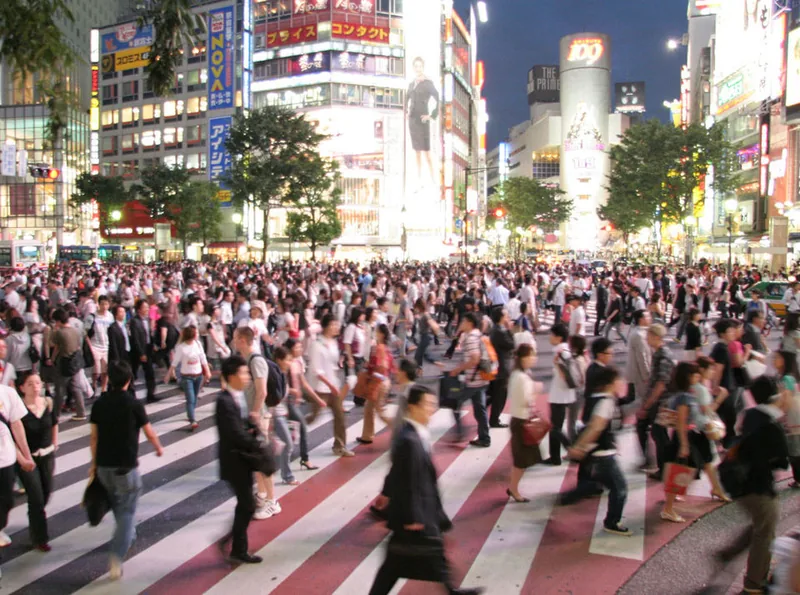 Photo: Shibuya district, Tokyo, at night. Otomo studied Tokyo’s neon-drenched nocturnal landscape to design Neo-Tokyo: the city as a living system of competing light sources, each changing the color of every surface it touches. Photo by Bantosh / CC BY 2.5 / Wikimedia Commons
The industry could have easily said no. In 1986 and 1987, anime still largely occupied a niche market, cartoons for children and teenagers, or science fiction for adults willing to accept television-level technical standards. Japanese animated films rarely exceeded modest budgets and seldom found significant distribution outside of Japan. The production committee that financed Akira brought together powerhouses like Toho, Tokyo Movie Shinsha, and Kodansha, among others. They agreed to bankroll ¥700 million: somewhere between $5.5 and $8 million in contemporary conversions, depending on the source. This made it the most expensive anime ever made up to that point, a record that would only be surpassed a year later by Hayao Miyazaki’s Kiki’s Delivery Service.
The true value of this extraordinary investment manifests in the technical choices made throughout the film. The 160,000 cels, each a product of painstaking hand-drawn artistry. The final palette boasted 327 distinct colors, 50 of which were created exclusively for Akira. This bespoke color design aimed to capture the subtle variations of nocturnal illumination in a neon-drenched city. The skin tone of a character standing under a yellow lamp is not the same as the skin tone of that same character under a blue lamp, and Akira treated these differences with the meticulous seriousness typically reserved for live-action cinema. This attention to environmental lighting and its effect on color was revolutionary for animation.
One technical decision that few critics comment on, yet profoundly impacted the film, was Otomo’s choice to record the dialogues before animating the scenes. In Western animation, this has been standard practice since the 1930s. Disney always worked this way. In Japanese anime, however, the opposite was true. Voice actors typically watched the already completed animation and then recorded their lines to match. Otomo inverted this process. He recorded the dialogue first, then animated the characters’ lips to precisely synchronize with the rhythm and cadence of the spoken words. Akira was the first anime to adopt this method. The result is a striking realism: the characters appear to speak genuinely, rather than merely dubbing over pre-existing animation. This added another layer of authenticity that further distinguished the film from the prevailing standards of its era.
The motorcycle scene, proportionally, received more investment than almost any other sequence in the film. It served as the ultimate showcase, the visual argument Otomo needed to justify the seemingly absurd budget. And it was here that Hitoshi Ueda and Koji Morimoto delivered precisely what the production required: a thirty-second proof of concept that encapsulated the entire film’s ambition and technical prowess. It was a promise made manifest, a glimpse into a future of animation that few had dared to imagine.
The Scene Hollywood Keeps Copying
The influence of Kaneda’s slide extends far beyond mere casual homage. Directors meticulously study the original scene, frame by frame, and then carefully reconstruct it within their own cinematic contexts. The list of these conscious tributes is long, and it continues to grow.
The earliest recorded homages appeared in comic books. By the 1990s, American illustrators began drawing their own versions of the Kaneda slide in underground magazines, a subtle nod among creators. When this influence migrated to film and television, it became far more noticeable, primarily because recreating the scene in motion demands significant time, resources, and technical skill.
Today, in 2026, the list of major cinematic and television tributes includes:
- Star Wars: The Clone Wars (animation, 2008-2014)
- Adventure Time, episode “Go With Me” (2010)
- X-Men Origins: Wolverine (2009)
- Teenage Mutant Ninja Turtles (2003 animated series)
- Ready Player One (Steven Spielberg, 2018)
- Sonic the Hedgehog (2020)
- The Batman (Matt Reeves, 2022)
- Nope (Jordan Peele, 2022)
Each of these references is a deliberate act of homage. This is not a coincidence of “two motorcycles stopping in a similar way.” It is a precise reconstruction of the original frame. The angle of the shot, the play of light and shadow, the rider’s posture, the exact arc of the skid, all are carefully replicated. Directors and visual effects teams pore over the original scene, frame by frame, striving to recreate its essence within the aesthetic of their own films. For instance, in Ready Player One, Spielberg’s reverence for Akira is clear as the scene is recreated with stunning fidelity in a virtual world, emphasizing the enduring power of the original. The Batman uses a similar visual language to establish its protagonist’s commanding presence, while Nope employs the slide to punctuate a moment of intense action and character resolve.
Why this particular scene? The answer lies in both its technical brilliance and its narrative potency. The technical reason, as previously discussed, is the unparalleled level of detail and fluidity. It represents a pinnacle of hand-drawn animation that few have matched. The narrative reason is perhaps even more compelling: the scene condenses, into thirty seconds, a powerful idea that directors universally adore conveying. It signifies a character’s forceful arrival, an undeniable mastery over their vehicle, and an attitude that declares, without a single word, “I know what I am doing, and I am here to accomplish it.” Kaneda on his motorcycle executes the perfect cinematic entrance. Filmmakers constantly seek such moments of impactful introduction, and Otomo inadvertently provided an instructional manual.
There is also a significant cultural dimension. For many years, making this reference served as a subtle signal among filmmakers, indicating a profound respect for anime as a serious cinematic language. Today, in 2026, it has simply become an assumed part of the cinematic vocabulary, a widely recognized trope. But in 1995, or in 2003, when these tributes first began to appear, they functioned as a flag, a declaration. The director incorporating the scene was effectively saying: “I have seen Akira, I recognize its importance, and I am embedding that recognition directly into my own film.” It was a way for creators to connect with a shared understanding of cinematic excellence, acknowledging a masterpiece that transcended its genre and origin.
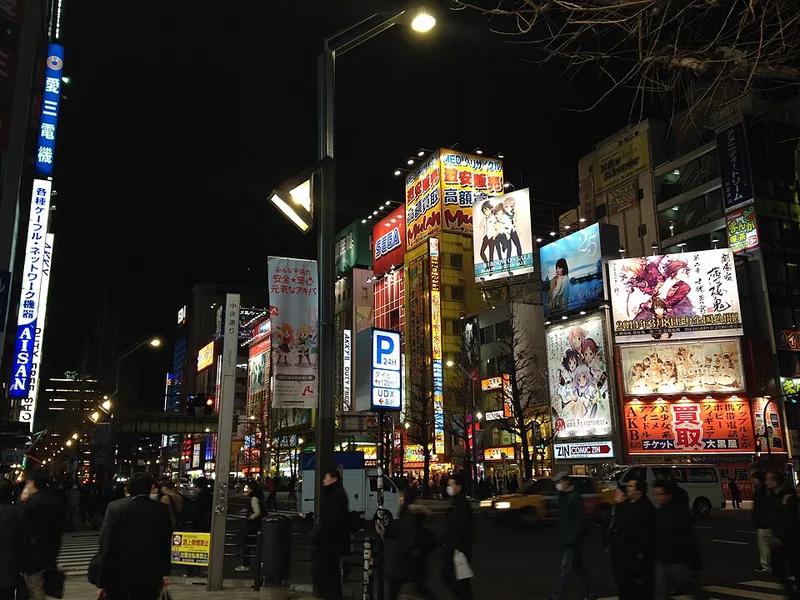 Photo: Chuo Street crossroad at night near Akihabara Station, Tokyo — the district whose competing vertical neon sources Otomo compressed and amplified into Neo-Tokyo’s saturated light architecture. Photo by Soramimi / CC BY-SA 3.0 / Wikimedia Commons
What These Thirty Seconds Prove
The ultimate lesson of Akira does not reside solely in the film itself. It speaks to what happens when someone refuses to take shortcuts and instead dedicates the time and effort that true art demands.
The story of Akira is one of exception. No one would adopt 24 frames per second full animation as an industry standard, it is simply too expensive, too time-consuming, and requires too large a team. Even today, Japanese animation, despite its often breathtaking quality, still blends economical techniques with specific moments of maximum fluidity. Neither Studio Ghibli, nor MAPPA, nor Production I.G maintains 24 frames per second for an entire film. The market simply cannot support such a consistent level of expenditure.
What Akira unequivocally demonstrates is that when someone accepts the cost and proceeds anyway, the resulting work endures in a way that “efficient” productions cannot. In 1988, dozens of anime films premiered with standard budgets, standard techniques, and standard results. Most of them faded into obscurity. Akira remained. It did not persist merely because it possessed a better plot, superior music, or more compelling characters, though it certainly boasts all of those qualities. It endured because every single frame was crafted as if it were the only frame that would ever exist.
The motorcycle scene functions as the film’s entire thesis, presented in the form of irrefutable proof. Thirty seconds of technical obsession contained within a film that spans nearly two hours. And it is precisely this concentrated, dense, and utterly unsparing format that Western directors instinctively recognize when they watch it. One cannot fake this kind of meticulous work. One cannot rush it. One cannot outsource the fundamental artistic commitment. The individuals who drew that scene spent weeks, perhaps months, perfecting it. And the audience feels that dedication, even if unconsciously.
The lesson of Akira, in 2026, transcends mere technicality. It is philosophical. Handcrafted work, given sufficient time and care, ages differently than industrial production rushed to meet deadlines. Hitoshi Ueda and Koji Morimoto were not attempting to create a global reference point. They were simply striving to make a good scene. That good scene became a reference because it was genuinely good: not because someone bought marketing, not because someone paid for its repetition, not because it became a meme. It became a reference because every animator, every filmmaker, every film student who witnessed it recognized the presence of something rare: the work of those who accept the imperative to spend the time that the art demands.
Today, in Tokyo, animators still learn their craft by studying this scene. Frame by frame. Line by line. Color by color. In some studio in Suginami, right now, someone is looking at those thirty seconds by Hitoshi Ueda and Koji Morimoto, trying to understand what they achieved that no one after them has quite managed to replicate with the same level of profound impact. This process of learning will never conclude. That is the enduring truth these thirty seconds prove.