The Kamehameha Was Not Toriyama's Invention. And He Always Said So
Akira Toriyama did not invent the Kamehameha. The most famous energy attack in television history was borrowed from a Hawaiian king, and Toriyama spent decades saying so.
Akira Toriyama did not invent the Kamehameha. The most famous energy attack in television history, a technique that defined the visual language of action animation for nearly forty years, was borrowed. Toriyama admitted this himself, without hesitation or defensiveness, in an interview published in the official 1995 Daizenshuu databook. The name itself came from his wife, while a nineteenth-century Polynesian monarch provided the historical foundation.
On April 16, 1986, at seven in the evening, Japanese families gathered around their dining tables to watch the eighth episode of a young animated series called Dragon Ball. The episode, titled Kamesen’nin no Kamehameha (translated as “Master Roshi’s Kamehameha”), introduced a sequence that altered the trajectory of the medium. Master Roshi, an eccentric old martial artist wearing sunglasses and a Hawaiian shirt, stood on the slopes of Fire Mountain alongside a young Goku. Roshi drew his hands back to his hip, cupped his palms, and concentrated his energy. He shouted a four-syllable sequence that no anime audience had ever heard: “Ka. Me. Ha. Me. HA.” A concentrated beam of blue light erupted from his palms, vaporized the mountainside, extinguished the raging forest fire, and demolished the castle of the Ox-King. Moments later, Goku replicated the technique in a mere fifty seconds, a feat that had taken Roshi fifty years of intense training to master.
This moment of television history did not spring entirely from Toriyama’s solo imagination. In the mid-1980s, the production environment at Toei Animation and the weekly serialization schedule of Weekly Shonen Jump demanded rapid creative decisions. When Shueisha published the Daizenshuu (the official series databooks) in 1995, Toriyama used the platform to clarify the origins of his work. In the Story Volume of the collection, he addressed the creation of the move with characteristic simplicity, stating that the name was taken directly from King Kamehameha of Hawaii.
The creative process behind the attack reveals the collaborative nature of Toriyama’s household. During the early development of Dragon Ball, Toriyama found himself stuck. He knew he wanted Master Roshi’s signature technique to begin with the word “kame” (the Japanese word for turtle, written as 亀) as a direct tribute to the character’s identity as the Turtle Hermit. However, he could not find a way to complete the phrase. He turned to his wife, Yoshimi Kato, a professional mangaka who published under the pen name Nachi Mikami. Kato was already familiar with Toriyama’s creative demands, having previously assisted him with background illustrations and scenery for Dr. Slump when his weekly deadlines became unmanageable.
Kato offered a highly practical solution. She suggested using a name that Toriyama would easily remember without constant reference sheets. Her mind turned to King Kamehameha I, the historical ruler who unified the Hawaiian islands and established the Kingdom of Hawaii in 1810. The suggestion carried a double meaning that fit Toriyama’s comedic sensibilities. In Japanese, “ha” (written as 波) translates to “wave.” By combining the historical name with the Japanese language, the phrase became a bilingual pun that perfectly suited the Turtle School: Kame (Turtle), Ha (Wave), Kame (Turtle), Ha (Wave). Toriyama adopted the suggestion immediately. In one of the few long interviews he gave about the genesis of the series, in the Story volume of the Daizenshuu, he recorded the matter without ceremony: “Of course, it’s taken from King Kamehameha of Hawaii.”
The contribution of Yoshimi Kato extended beyond the linguistic pun. She also designed the physical mechanics of the attack. The specific posture (the deep stance, the hands cupped against the hip, the slow concentration of energy, and the forward thrust accompanied by a syllable-by-syllable shout) was her concept. This collaborative origin is documented in production retrospectives and industry analyses, including reports by CBR and subsequent editions of the Shueisha databooks. While Toriyama popularized the gesture through his illustrations, the physical choreography belonged to his wife.
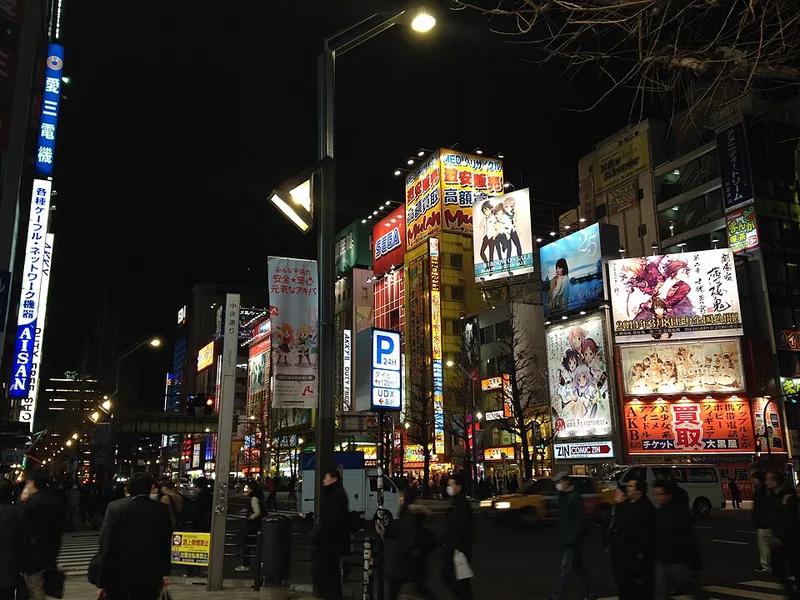 Chuo Street crossroad, Akihabara, Tokyo — the neighbourhood where Weekly Shōnen Jump was distributed from the Shueisha offices nearby, and where the Kamehameha became a household name in 1986. Soramimi / Wikimedia Commons (CC BY-SA 3.0)
The Hawaiian Meaning Nobody Read for Forty Years
There is a deeper linguistic layer to this name that remains largely unexamined in Western commentary. In the footnotes of the original Daizenshuu, which were later translated into English by the archival website Kanzenshuu, the Japanese translator noted the precise Hawaiian etymology of the monarch’s name. The correct linguistic division of the word is not “Kamehame-Ha,” but rather “Ka-mehameha.” In the Hawaiian language, “Ka” serves as a definite article meaning “the person,” while “mehameha” translates to “lonely” or “solitary.” Together, the components form a title that translates to “the lonely one” or “the one set apart.” The original Japanese translator concluded the footnote with a poignant observation, noting the mystery of a great hero who is defined by solitude.
While Toriyama never explicitly confirmed that he intended this thematic connection, the narrative trajectory of Son Goku aligns closely with this etymological definition. Goku is a protagonist who repeatedly isolates himself from his family, his friends, and domestic life to pursue solitary training in remote mountains or distant worlds. Across dozens of animated specials, multiple series conclusions, and numerous martial arts tournaments, Goku consistently retreats into isolation before returning to defend his world. A name that began as a simple mnemonic device eventually served as a precise description of the character’s fundamental nature.
The broadcast of episode 8 on April 16, 1986, established a visual blueprint that still governs the action animation industry. Directed by Daisuke Nishio and Yoshihiro Ueda, the episode presented the sequence with a specific cinematic grammar: the low-angle shot of the feet, the gathering of energy between the palms, and the sudden frontal projection of a linear beam. This visual structure has remained virtually unchanged through decades of adaptation.
Nearly forty years later, almost every standard energy projection in shonen media relies on a variation of this choreography. The influence is visible in the physical execution of Naruto’s Rasengan, the focused release of Bleach’s Getsuga Tensho, the direct physical thrust of Luffy’s Gum-Gum Pistol, the concentrated energy of the Espada’s Cero, and the spherical projection of Kurama’s Tailed Beast Bomb. The impact extends beyond anime into the video game industry. Capcom designer Akira Nishitani confirmed in historical interviews that the Hadoken, introduced in the original 1987 Street Fighter arcade game, was designed as a direct homage to Toriyama’s work. When Toriyama borrowed the name of a Polynesian king, he established a physical vocabulary that defined the action genre.
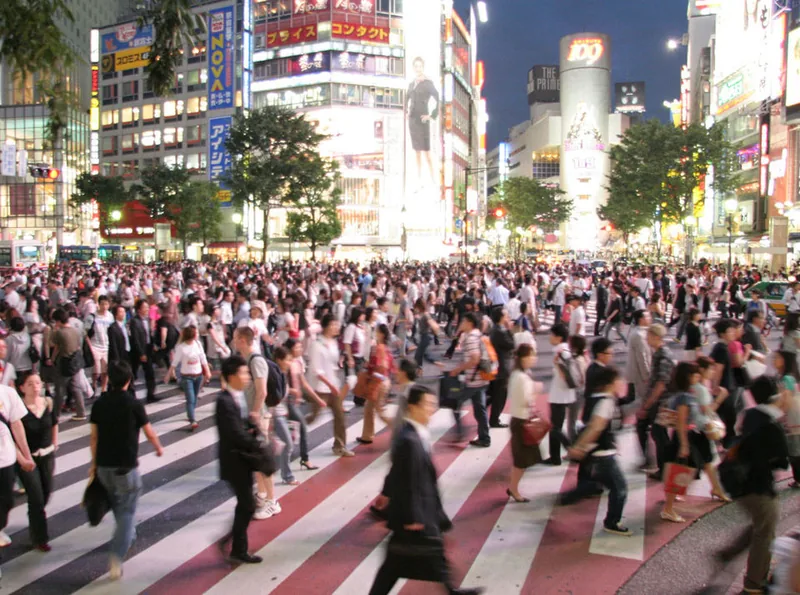 Shibuya district, Tokyo, at night. In March 2024, at the Fuji TV upfront presentation in Tokyo, Masako Nozawa — Goku’s voice actress since 1986 — led the entire corporate audience in a final Kamehameha to honour Toriyama. Bantosh / Wikimedia Commons (CC BY 2.5)
March 2024: One Final Kamehameha
Akira Toriyama passed away on March 1, 2024, at the age of sixty-eight, due to an acute subdural hematoma. Bird Studio announced his passing one week later, prompting a period of national reflection in Japan and widespread mourning across global social media platforms. The formal, institutional tribute to his legacy occurred on March 11, 2024, during the official announcement of the upcoming series Dragon Ball Daima at the Fuji TV upfront presentation in Tokyo.
Masako Nozawa, the eighty-seven-year-old voice actress who has portrayed Son Goku since she first recorded for the pilot episode in February 1986, took the stage. She requested that the entire corporate audience stand. Nozawa assumed the familiar stance, drawing her hands back to her hip. The audience followed her lead, mirroring the gesture. She concentrated, raised her voice, and delivered the familiar chant: “Ka. Me. Ha. Me. HA.”
The gesture had traveled from an early nineteenth-century Hawaiian monarch, through the domestic advice of a Japanese mangaka in 1984, into the broadcast booths of Tokyo in 1986, before returning to honor Toriyama one final time in a corporate conference hall in 2024. The creator of the series had spent decades reminding his audience that he did not invent the technique. Yet the people who gathered to honor his memory understood exactly what he had given to the world.