
Special: Spirited Away — Part 2: Kaonashi Lives in All of Us
Miyazaki added Kaonashi late in production to solve a structural problem — and created the film's sharpest allegory: an emptiness that learns the only language its environment speaks.
This is Part 2 of 2. ← Read Part 1: The Bathhouse as a Labor Contract
Does Kaonashi, the enigmatic spirit from Spirited Away, truly reside within us all? In July 2001, weeks before the film’s premiere, Hayao Miyazaki held a press conference at Tokyo’s Imperial Hotel. Addressing Kaonashi, a character many viewers left the cinema still pondering, Miyazaki stated, “there’s probably a bit of Kaonashi in all of us.” He further elaborated, as recorded in the Ghibli Wiki citing the press release: “there are Kaonashi all around us. There’s only a paper-thin difference between evil spirits and gods. And on top of that, this film is set in Aburaya, a bathhouse.” Seven years later, in 2008, in the interview collection Orikaeshiten (折り返し点, “Turning Point”), published by Iwanami Shoten, he revisited this idea with greater calm. The phrase has since become a common citation in Japanese critical discourse, though it appears less frequently in Western texts, often without proper attribution. Yet, it holds the key to the entire film.
A crucial prior fact shapes our understanding: Kaonashi did not exist in the original screenplay. Spirited Away began in 1999 as a project titled “Entotsu Gaki no Rin” (Rin of the Chimney Roof), featuring a 20-year-old female character painting a mural on a bathhouse chimney. Studio Ghibli producer Toshio Suzuki recounts this story in the making-of documentary, a detail found in various compilations. Miyazaki abandoned that project, restarting from scratch with the daughter of family friends, Chiaki, in mind, and drew what would become Chihiro. Kaonashi himself only emerged late in pre-production when Miyazaki realized the film, with its existing structure, already exceeded three hours. He needed a character to synthesize the central thesis within a single body, through a swift arc, without subplots. Kaonashi was born from a time constraint, which explains why he carries such immense thematic weight.
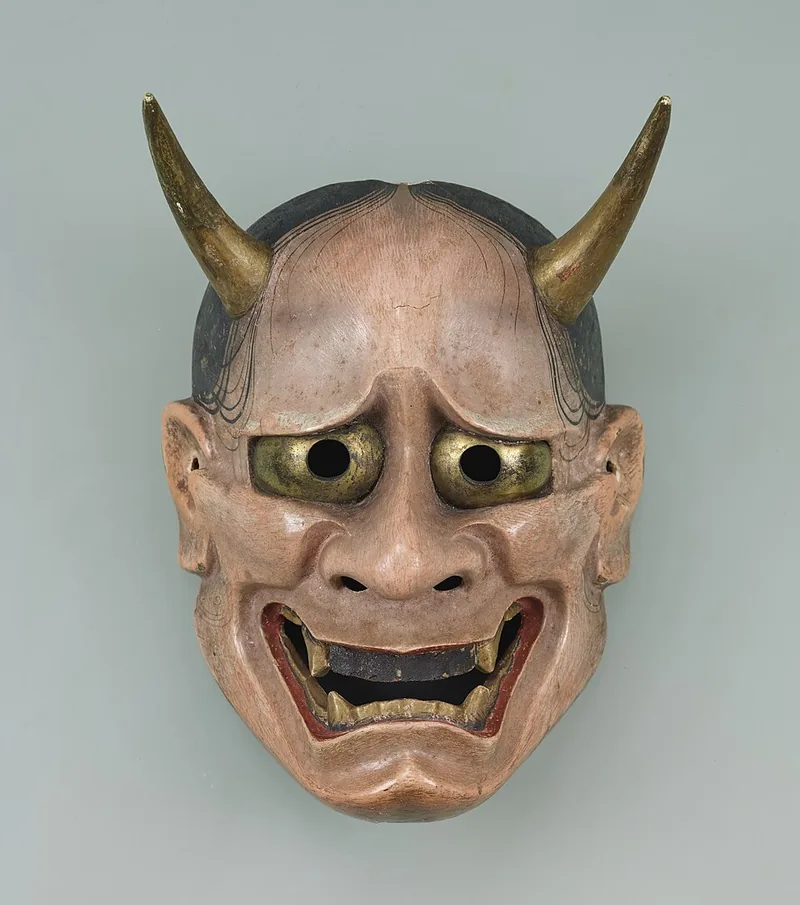 Photo: Noh theater mask, Japan. Miyazaki based Kaonashi’s appearance on the blank white masks of Noh theater, where the mask becomes a canvas onto which the audience projects emotion. Photo by SLIMHANNYA / CC BY 4.0 / Wikimedia Commons
Kaonashi (顔無し), literally “without a face,” first appears standing in the rain outside the bathhouse. He wears a white Noh theater mask, with two eye slits and a mouth that looks like a child’s drawing. He possesses no defined body, merely a translucent black silhouette that floats. At this moment, before entering, he embodies purity. Empty, yes, but pure. He covets nothing because he knows nothing.
Chihiro sees him and performs the gesture that changes the film’s trajectory: she gently opens the bathhouse door for him, assuming he is another guest arriving for purification. He is not. Inside, Kaonashi learns the first thing that enters the life of someone empty: the currency of the place. And the bathhouse’s currency is gold. The employees crave gold. Guests pay with gold. Yubaba counts gold. Bo plays with shiny objects. The entire establishment speaks a single language, and that language is the only thing modern society offers to fill inner emptiness.
The Empty Self and the Only Language the Bathhouse Speaks
In 1990, a decade before Spirited Away premiered, American psychologist Philip Cushman published an article in American Psychologist titled “Why the Self is Empty.” His thesis became a benchmark: twentieth-century consumer society created a type of person who feels perpetually empty inside, and advertising teaches them to fill this void with products. Not with affection, not with community, not with meaning. With products. This model of society knows how to sell nothing else. Eleven years after Cushman, Miyazaki created a film that demonstrates this entire thesis in action. No evidence suggests Miyazaki read Cushman. He did not need to. The diagnosis is not specific to an American psychological school; it represents an observation of the turn of the millennium, and in 2001, it permeated the air.
Kaonashi stands as the pure allegory of this. An emptiness enters a place that speaks only one language, and he learns that language because it is the only one spoken. He begins to produce gold from nothing. Nuggets, coins, mountains of gleaming metal. The employees go mad. They treat him like royalty. They serve excessive food. They flatter him. They fight over a single coin as if it were a promotion.
Kaonashi devours everything. He devours food, he devours employees, he devours everything he receives. He grows. He becomes monstrous. Not because he is inherently evil, and not because he is lonely and seeks friends. It is colder than that. It is the system operating precisely as designed. I offer gold, you accept, I grow. I offer food, you eat, I grow. This represents the basic equation of consumer capitalism, embodied in a character who has nothing else to offer because the place teaches nothing else.
Then Chihiro enters. When Kaonashi approaches her with both hands full of gold, she says no. Not aggressively, but with clarity. She does not want gold. She wants to save Haku, who is dying. She wants to find her parents. She wants to return home. Her priorities do not appear on the list Kaonashi knows how to offer. He cannot process this. He increases his offer. Chihiro continues to say no. Kaonashi grows larger, becomes violent, opens his enormous mouth, threatening to swallow her as he swallowed everyone else. This is not rage. It is a system collapse. Someone has arrived whom he cannot capture with the only language he possesses.
The most important line in the film comes from Rin (リン), Chihiro’s coworker. When Chihiro asks what to do with Kaonashi, Rin responds, in approximate translation: he is only strange because he is here. Take him out of here, and he will return to who he was.
This encapsulates the entire thesis. Kaonashi is not evil. He represents the form that pure emptiness assumes when the only place offered for it to learn about the world is a place that speaks only of gold. Removing Kaonashi from the bathhouse means removing capitalism from the context where it only knows how to operate as capitalism. In another place, with another currency, it can become something else.
When Chihiro offers Kaonashi part of the medicinal dango, the bitter pellet she received as gratitude from the river spirit, made of gratitude and not gold, something pure enters that emptiness. Kaonashi vomits everything he had swallowed. Employees, food, gold, greed. He returns to his original size. He leaves the bathhouse, following Chihiro. And he boards the train.
On the train, Kaonashi visually resembles the other passengers. Here lies the warning. At each station, human shadows cross the scene and vanish. Faceless, voiceless, with nothing to distinguish them from one another. One can interpret these passengers as echoes of the sarariman of the 80s and 90s: silent figures in suits, returning home after a routine that seems to have erased their faces.
Kaonashi resides in all of us. Not as loneliness, not as sadness, not as emotional deprivation. He resides as the emptiness that capitalism has learned to fill with the only thing it knows how to offer. And when someone (Chihiro, with her intact purity) refuses the package, the system panics before finally learning to calm itself.
Why Chihiro Returns with Her Name
She navigates everything without corruption. Not because she is a hero, but because she possesses values. The film clarifies what values mean when the system offers something else entirely.
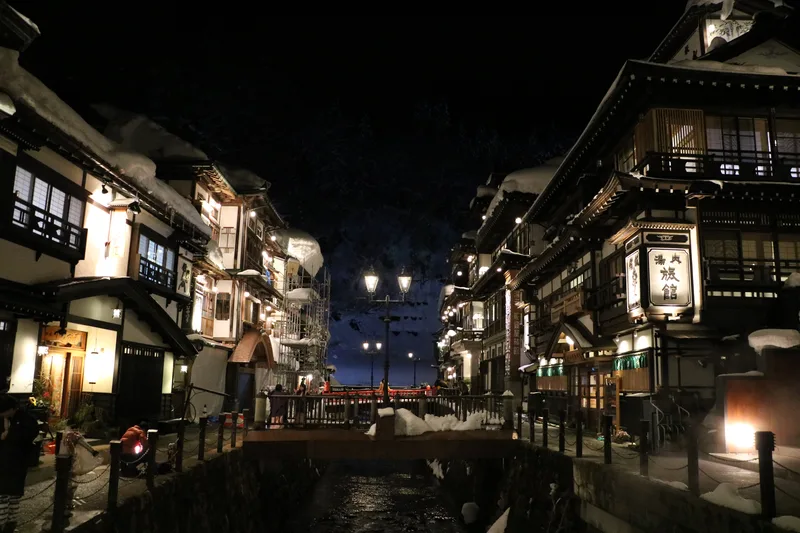 Ginzan Onsen at night, Yamagata Prefecture — traditional wooden ryokan buildings reflected in the river, one of the real onsen towns Miyazaki drew on when designing the Aburaya bathhouse. さかおり / Wikimedia Commons (CC BY-SA 4.0)
The train journey ends at the house of Zeniba (銭婆), Yubaba’s twin sister. Zeniba is her sister’s opposite in almost every way. She lives in the countryside, outside the bathhouse. She cooks. She knits. She welcomes Chihiro with warm tea. She also welcomes Kaonashi, without alarm.
The important detail is that no gold circulates there. There is no contract. No transaction. Zeniba knits a hair tie for Chihiro and gives it to her as a gift, handmade, without charge. This represents the film’s most radical gesture. In a place where addiction is not the currency, addiction ceases to operate.
There, Kaonashi finds purpose. Not by swallowing, not by buying, not by accumulating, but by knitting, slowly, silently, beside Zeniba. He does not speak, but his expression adjusts. Remove emptiness from the place where everything becomes gold, food, and dispute, and it stops functioning as a monster. It becomes a useful, quiet presence, capable of serving others without needing to devour them first. Cushman’s concept of the empty self disconnects because the local advertising is no longer active.
Back at the bathhouse, Chihiro confronts Yubaba one last time. The old woman lines up pigs and asks Chihiro to identify her parents. Chihiro looks and responds, without hesitation: none of these are my father or my mother. She is correct. Yubaba was bluffing. Chihiro does not solve a trick; she understands the rule. She still remembers exactly who her parents are. The system did not erase her. The kotodama of her name returned whole. She passed every trial, retaining the values she brought with her: kindness to those in need, responsibility for others, keeping her word, firm refusal of what would corrupt her.
When Chihiro remembers Haku’s true name (Nigihayami Kohakunushi, 饒速水小白主), he recovers everything. In the form of a white dragon, he carries Chihiro back to the bathhouse gate. There, holding hands, he says he will be fine now. He asks her not to look back as she crosses.
This moment stands as the film’s most delicate. Chihiro is not doing Haku a favor. She is making restitution. He was expelled from his own home by a human choice that did not consult the kami: a river filled in to construct buildings, and along with the river, the identity of the spirit that lived within it. When Chihiro returns his name, she also returns the recognition the system had erased. A small gesture, made by a ten-year-old child, reverses part of what decades of modernization had undone. Miyazaki here shows the part remaining in the hands of younger generations: remembering the names erased by previous generations.
She crosses the tunnel. The car is covered in leaves and dust, as if time had passed differently. In the world of the kami, time does not align with human time. Her parents emerge normally, remembering nothing. Shaking off the dust, eager to reach their new home. Normal life resumes. But Chihiro, in the final scene, touches the hair tie braided by Zeniba, which still rests in her hair. The tie glows faintly, reflecting the afternoon light. She smiles, alone. Her parents do not see. This is the gift. It is not material proof. It is not a story she can tell without sounding crazy. It is a handmade object, outside the system, given from the heart. The only thing capitalism never knew how to produce, and therefore the only thing it cannot take from those who carry it.