
Kiki Lost Her Magic. Or Just Her Illusions?
Hayao Miyazaki's Kiki's Delivery Service explores adolescence not as a magical adventure, but as a profound journey of losing innocence and confronting the world's indifference.
What happens when a young witch, bursting with talent and hope, discovers her magic isn’t enough to navigate an indifferent world? Hayao Miyazaki’s beloved Kiki’s Delivery Service is far more than a charming tale of a girl and her flying broom. It is a subtle, poignant exploration of growing up, revealing that maturity means confronting a world less gentle than anticipated, and understanding that even the purest talent can break under the weight of expectation, comparison, and the fear of failure. The film masterfully unpacks the quiet disillusionments that shape us, showing Kiki’s journey as a universal passage from naive optimism to a more grounded, conscious resilience.
The source is Eiko Kadono’s novel Majo no Takkyūbin (魔女の宅急便), first published in Japan by Fukuinkan Shoten in 1985. Kadono has said the story grew from sketches her daughter Rio made at age twelve: a witch on a broomstick carrying a radio. Hayao Miyazaki wrote, produced, and directed the film adaptation, which opened in Japan on July 29, 1989.
Kiki embarks on her traditional witch’s journey at thirteen, a coming-of-age ritual requiring her to choose a new city, live alone for a year, and discover how to use her unique gift to serve others. On the surface, this sounds like an exhilarating adventure: a young girl, her broom, a black cat, and the boundless sky awaiting her. Yet, Studio Ghibli, under the meticulous direction of Hayao Miyazaki, never frames her departure as an unmitigated triumph. The scene certainly possesses a joyous quality. Kiki radiates pride, eager to prove her capabilities, determined to show her family she has matured. Despite this spirited enthusiasm, a delicate vulnerability underscores her demeanor. She is not prepared for the reality of the city; she is prepared only for the romanticized idea she has constructed of it, an ideal fostered by the sheltered world she knows. This distinction, often overlooked, lays the groundwork for the profound lessons Miyazaki intends to impart.
This is the initial, exquisitely subtle point the film conveys. Kiki does not depart with a blank slate; she leaves laden with preconceived notions. She imagines people will be inherently kind, her magic universally admired, work opportunities naturally abundant, and that merely flying will secure her place in the world. This represents the innocence of someone who has yet to experience rejection, a person whose expectations remain untainted by the harsh edges of reality. Furthermore, Kiki carries a nascent form of prejudice, not a malicious bias, but an immature reading of people and situations. She arrives believing the world will instantly recognize her inherent goodness. When this immediate validation fails to materialize, she recoils. She views the bustling city through the lens of expected automatic welcome, instead finding hurried indifference, impersonal shop windows, fast-moving cars, preoccupied customers, and girls her own age who seem to inhabit an entirely different universe. The loss of innocence begins at this precise moment: not when she tumbles from her broom, nor when her magic wanes, but when she realizes that being good does not guarantee being understood, acknowledged, or even noticed. Kiki does not lose her magic abruptly; she first loses the childlike certainty that the world would know how to recognize her true self.
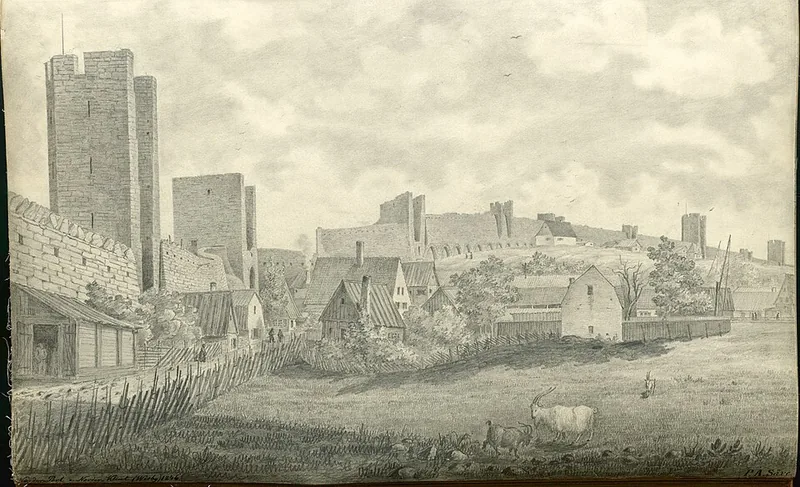 Photo: Visby, Gotland, Sweden. Hayao Miyazaki visited Visby while designing Koriko: its medieval walls, terracotta rooftops and hillside streets are the direct visual reference for Kiki’s city. Photo: Swedish National Heritage Board / No restrictions / Wikimedia Commons
The fictional city of Koriko, a picturesque port town brought to life with Studio Ghibli’s signature artistry, is one of the most carefully observed urban environments in animation. Its quaint rooftops, sparkling bay, charming streetcars, inviting storefronts, and winding, hilly streets appear endlessly welcoming from a distance. However, as Kiki descends into its heart, the city does not genuflect before her magic. No one there has been waiting for her. This particular detail lands a harsh blow, shattering the fantasy of the “special child.” Kiki is a witch; in many other narratives, this innate identity would suffice to garner universal admiration. In Miyazaki’s world, it simply isn’t enough. The adult world does not begin by asking about your dreams; it asks what you can do, what it costs, if you can arrive on time, if you can solve a tangible problem. Kiki arrives brimming with pride in her gift, only to discover that talent, devoid of social function, sustains no one. Flying is beautiful, indeed. But flying to deliver something to someone, on schedule, through a downpour, with responsibility, is an entirely different proposition. It demands accountability, reliability, and a focus beyond personal expression.
This is where Kiki’s Delivery Service becomes far more mature than its whimsical veneer suggests. The city does not act as a villain. The people are not inherently malicious. They simply do not revolve around Kiki’s existence. This revelation wounds Kiki more profoundly than any explicit rejection might. It mirrors the formative experience of countless adolescents: the painful, quiet realization that the world continues to function perfectly well, regardless of whether you feel lost within it. Her initial act of flying, soaring through the sky, is an expression of identity, a natural extension of her being. Kiki mounts her broom as effortlessly as she breathes, chatting with Jiji, feeling the wind, observing the world from above. Her magic is spontaneous, unburdened by measurement or external judgment. But then, she transforms this intrinsic gift into a profession. The delivery service is born. What was once unbridled freedom morphs into a demanding schedule: retrieve packages, protect contents, brave storms, satisfy customers, accept payment, maintain a cheerful demeanor even when exhausted.
Miyazaki here illuminates one of the most silent, yet pervasive, pains of adult life: the moment when something that was once an effortless, natural part of us transmutes into a performance. Drawing becomes a deadline. Writing becomes a deliverable. Caregiving becomes an obligation. Flying becomes a service. Kiki does not resent working; the film never suggests this. Quite the contrary: her work provides her with a place, an income, relationships, and a sense of utility. The true problem lies elsewhere. She has not yet learned to separate her intrinsic value as a person from the outcomes of her labor. Each perceived failure feels like proof of her own inadequacy. Every indifferent customer seems to invalidate her existence. Each comparison to other girls her age appears to diminish her own unique being. Her magic begins to falter precisely because Kiki starts to wield her gift as a plea for validation from the world: “Can I exist here? Am I good enough? Do you accept me now?” The city, for all its beauty, remains indifferent. It is within this emotional chasm that Kiki discovers that talent, however pure, does not guarantee belonging.
The City Girls, Tombo, and What Kiki Cannot Yet See
Kiki is not arrogant in the conventional sense. She is gentle, diligent, and courageous. Yet, she harbors a childlike notion about herself and others: she is the witch who arrived from elsewhere, distinct and special, and others ought to perceive her as such. When she encounters well-dressed girls in the city, Kiki inwardly shrinks. She dismisses them as frivolous, distant, almost natural adversaries. When she first meets Tombo, she judges him too quickly. He is curious, talks perhaps a bit too much, expresses an avid interest in flying machines, and attempts to forge a connection, yet Kiki responds with an unyielding coolness, as if his attention constitutes an invasion of her space. This forms one of the film’s most profoundly human aspects. Kiki, too, possesses her own prejudices. Not an ideological bias against a specific group, but a resistance towards individuals who do not conform to the pre-packaged image she had prepared for the world. She sees Tombo as an inconvenient boy. She perceives the city girls as inhabitants of a universe she cannot penetrate. She regards demanding clients and feels the entire city turning against her.
Adolescence often unfolds in this manner. One has not yet truly come to know others, and so, transforms them into symbols of one’s own insecurities. Tombo becomes the boy who embarrasses her. The elegant girls become proof of her perceived simplicity. The cold customer becomes evidence that her earnest efforts are worthless. Master Miyazaki refrains from condemning Kiki for these internal struggles. He understands them. The loss of innocence is not solely about discovering the existence of malevolent people. It is about realizing that we, too, can be unjust when we are afraid, when our own fears project onto others, distorting our perceptions.
The delivery of the herring pie stands out as one of the film’s most pivotal scenes, precisely because it lacks any grand tragedy. It is the understated nature of the moment that makes it so piercing. Kiki endures driving rain, biting wind, thick mud, and profound exhaustion. She performs beyond what is strictly required. She arrives soaked, utterly spent, yet she arrives. And the girl who receives the pie barely registers Kiki’s effort, her face a mask of mild displeasure at the coldness of the dish. For an adult viewer, this might simply appear as a difficult delivery handled by an ungrateful customer. For Kiki, it is a devastating blow to the core of her identity. She still believed that sincere effort would be met with sincere recognition. The scene teaches her the bitter truth: sometimes you give your absolute maximum, and the person on the other side barely notices, or simply doesn’t care.
It is at this point that her innocence truly fractures. Not because someone openly humiliates her, but because reality responds with stark indifference. The adult world is often not intentionally cruel; it is far worse: too preoccupied to notice the immense cost you bore to get there. After this disheartening experience, Kiki spots Tombo with the city girls, and the wound deepens. She conflates everything: her exhaustion, a pang of jealousy, shame, social comparison, and a pervasive feeling of not belonging. Tombo had done nothing inherently wrong. The girls, perhaps, had not either. But Kiki now views the world solely through the prism of her own pain. The scene of the cold pie imprints an adult truth upon Kiki: effort does not always guarantee recognition, no matter how pure or strenuous.
The cessation of Jiji’s responses is one of the most beautiful and widely discussed choices in the film. In many interpretations, Jiji represents Kiki’s inner child: the part of her that comments on everything, complains, jests, offers ironic observations, accompanies her, and translates the world into digestible terms. This makes his silence so potent. The film does not need to state that Jiji loses his voice for the entire world. What matters is that, for Kiki, he ceases to respond. Their unique connection has shifted, fundamentally altering their dynamic. This doesn’t happen because Kiki has become morally impure. It occurs because she has entered a different frequency, a new emotional landscape. She is tired, constantly comparing herself to others, striving to prove her worth, resentful of the city, annoyed with Tombo, and ashamed of her perceived inability to fit in. Her internal childlike voice might still exist, but she can no longer hear it clearly, its once lively, unfiltered presence now muffled by the cacophony of adolescent angst.
Miyazaki here portrays something exceptionally rare: maturing does not mean killing the inner child. It means losing easy access to it. When we are young, this voice speaks constantly, unfiltered and direct. As the demands of adult life begin to assert themselves, pressures of performance, deadlines, financial concerns, social appearances, and the pervasive fear of failure: that voice becomes increasingly muted, overshadowed by these external burdens. Jiji does not vanish entirely; rather, Kiki can no longer return to the same place of effortless connection she once shared with him. She has moved forward, leaving a part of her childhood understanding behind.
Kiki arrived in the city believing that being a witch would be sufficient to define her identity. But the city compels her to ask a more profound question: what kind of person are you when no one is impressed by your uniqueness? This forms the core of her existential crisis. She does not merely lose the power of flight; she loses the shortcut she used to explain herself. “If I fly, I am a witch. If I am a witch, I have a place. If I have a place, I am secure.” When her flight fails, this entire chain of self-definition collapses. This is why the scene depicting Kiki in bed, feverish and creatively blocked, resonates with such raw honesty. She is not merely physically ill; she is emotionally exhausted. Her body gives out because her identity has already faltered. She attempted to live as an adult while clinging to a childlike fantasy of immediate recognition. When that fantasy shatters, she has not yet forged a mature identity to take its place. The loss of her magic is the visual metaphor Miyazaki employs for adolescent burnout. Not the burnout of the modern office worker, but its earliest incarnation: the collapse of an individual who has transformed their intrinsic gift into a constant, exhausting test of personal worth.
Ursula, the painter living in the secluded forest, plays a pivotal role, precisely because she does not dismiss Kiki’s crisis as exaggerated drama. She recognizes it intimately. She understands what it means to lose access to one’s own talent, to stare at a canvas and find oneself utterly unable to create. She knows the frustration of pushing so hard that the gift begins to recede. The conversation between Kiki and Ursula is one of the most mature dialogues in Miyazaki’s entire body of work. Ursula offers no simplistic motivational formulas. She does not merely say, “Believe in yourself.” Instead, she offers something far more challenging and profound: sometimes, when inspiration fails, one must stop. Engage in something else. Walk. Sleep. Observe. Simply live for a while, free from the incessant pressure to produce.
This is an immense insight for anyone who creates, works, or seeks to prove their worth through a particular skill. Talent is not a machine that can be endlessly driven. It requires a relationship with the world, a connection that nourishes it. It needs time. It needs silence. When it becomes solely about production, it withers and dries up. Ursula also helps Kiki perceive another crucial truth: the gift does not return simply because one obeys an order. It returns when the individual reconstructs their relationship with themselves. Before Kiki can fly again, she must cease using flight as a courtroom in which to judge her own value. Ursula symbolizes the essential pause that saves talent: stepping away from the pressure to rediscover one’s authentic voice, allowing the magic to breathe and return on its own terms.
Tombo is often interpreted as the earnest boy fascinated by flying machines, almost serving as comic relief. However, his function is far more nuanced and delicate. He is an ordinary person utterly captivated by what Kiki does naturally. While Kiki was born flying, Tombo must build, study, fall, and try again. He loves the sky with a profound passion, despite having received no magical gift. This genuinely unsettles Kiki because it dismantles another one of her preconceived notions: the idea that only those born with a gift can truly understand its value. Tombo does not fly, but he takes flight, and the spirit of it, seriously. He is not superficial. He is not mocking her. He simply approaches her in a clumsy, genuine way. When Kiki rejects him or retreats into herself, the film refrains from portraying Tombo as a victim. It simply illustrates that Kiki is still learning to see people beyond what they represent to her insecurities. He is not merely an inconvenient boy. The city girls are not just rivals. The ungrateful client is not the entire city embodied. The world is far more complex than her pain allows her to perceive in that moment.
This constitutes another layer of her loss of innocence: letting go of the need to categorize people into simple, easily understood roles. Someone who appears frivolous might simply be living their life. Someone who seems irritating might be trying, however ineptly, to help. Someone who appears to be an enemy might simply be an individual who has not understood your pain, or whose own concerns overshadow their ability to perceive yours. It teaches Kiki that real connection requires moving beyond initial judgments and seeing the full, messy humanity in others.
The Borrowed Broom and the Return of Magic
In the film’s climax, the grand dirigible breaks loose, leaving Tombo precariously suspended in the air. The entire city watches, breathless. Kiki has no time for an elegant, internal resolution of her crisis. There is no training montage, no inspiring monologue, no inner music swelling to proclaim her newfound self-belief. There is only someone in immediate, desperate need of her. This is why her magic returns. It manifests not as a reward for some abstract self-confidence, but because her gift rediscovers a direction outside of her wounded ego. Kiki does not fly to prove she is special. She does not fly to conquer the city or win its approval. She does not fly to best the elegant girls, impress difficult clients, or reclaim the pristine image she once held of herself. She flies because Tombo’s life is in danger. The small detail of the improvised broom is also significant. She does not return mounted on the perfect, sleek broom from the beginning of the film. Instead, she uses a borrowed, unbalanced, awkward cleaning brush. Her flight is ungraceful, arduous, almost broken. But it works. Master Miyazaki here demonstrates that maturing is not about regaining an intact purity. It is about acting even after purity has shattered. Her magic returns, but it is different, because Kiki herself has returned to the world as a transformed person. Kiki flies again when her gift ceases to be a constant test of value and once more becomes a way to reach out and connect with another human being.
The conclusion of Kiki’s Delivery Service is undoubtedly happy, but it is not a return to the past. Kiki does not revert to being the exact same girl who left home. She remains in the city. She continues to work. She remains distant from her parents. She continues to grapple with customers, finances, schedules, loneliness, and living in community. The crucial difference is that she now understands the world better, and, perhaps more importantly, she understands herself better. She knows that not every person will recognize her effort. She knows she can sometimes judge others unfairly. She knows that talent does not prevent creative blocks or emotional stagnation. She knows that working with one’s gift can be perilous when that gift becomes the sole measure of personal worth.
She also learns that true independence does not mean needing no one at all. Osono, Ursula, Tombo, Jiji, the kind elderly woman who ordered the pie, each of them restores a piece of Kiki that she could not have rebuilt alone. Adult life is not the heroic solitude she once imagined. It is a complex network of small, humbly accepted dependencies, sustained by mutual support and understanding. This, perhaps, is the film’s most beautiful message. Growing up is not about shedding innocence to become cynical or hard-hearted. It is about losing a simple, unexamined innocence to gain a more conscious, resilient kindness. The child believes the world will be good because she is good. The adult learns that the world can often be indifferent, and decides, even so, to continue being good without demanding immediate applause or recognition.
What Kiki truly loses is not merely her magic. She loses the illusion that being special is enough to navigate life. She loses the certainty that genuine effort will always be seen and rewarded. She loses the fantasy that people exist primarily to confirm the image she holds of herself. She loses the easy, unfiltered voice of childhood, the one Jiji so perfectly represented. Yet, this loss is not destruction. It is a passage, a necessary transformation. Master Miyazaki crafts Kiki into one of the most human characters in his cinematic universe precisely because he does not transform her into a flawless symbol. She is kind, yet she judges. She is courageous, yet she compares herself to others. She is talented, yet she experiences crippling creative blocks. She wants to help, but she also yearns for recognition. She loves to fly, but she suffers when flying becomes an obligation, a chore.
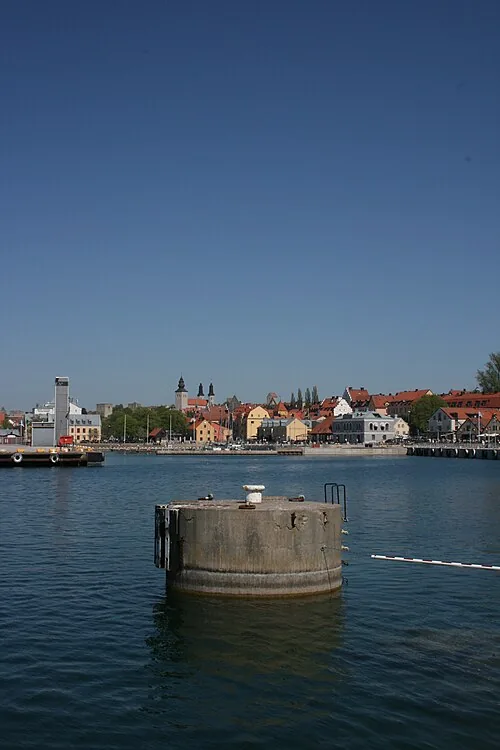 Photo: Harbor of Visby, Gotland — the same Baltic port whose medieval rooftops and sea-facing hillside Miyazaki used as Koriko’s template. Kiki’s first descent over the city echoes this exact topography. Photo by VisbyStar / CC BY-SA 4.0 / Wikimedia Commons
And perhaps this is why the film maintains such enduring power. Because almost everyone, at some point, has been Kiki. Someone who left home (literally or emotionally) believing the world would quickly understand them. Someone who discovered that talent offers no shield against loneliness. Someone who confused their work with their core identity. Someone who stopped hearing their own inner voice and feared they had lost their magic forever. Kiki flies again. But not because she returns to a state of pristine innocence. She flies again because she navigates the first profound loss of her innocence without allowing bitterness to become her new identity. This is Master Miyazaki’s enduring gift. He does not sugarcoat the process of growing up. He acknowledges that growing hurts, confuses, humbles a little, and silences some old, cherished voices. But he also insists that if one does not entirely shut down, if one remains open, something vital can still begin to move again. Perhaps adult magic is precisely that: not the purity of never having fallen, but the silent, profound strength to fly again, knowing full well that the world will not always applaud your efforts.