
Kokuhō: the Film About an Outsider Breaking into Kabuki Was Made by an Outsider
Kokuhō, the highest-grossing live-action Japanese film in history, follows a yakuza boss's son trying to break into kabuki, Japan's most hereditary art. It was directed by Lee Sang-il, a Korean born in Japan who kept his Korean name. Real kabuki, the onnagata, the rule of blood, and why the film revived a dying art.
There is a scene in Kokuhō (国宝, “national treasure”) in which the lead, Kikuo, performs Sagimusume, The Heron Maiden, one of the hardest dances in the onnagata repertoire. The onnagata is the male actor who plays female roles. The camera does not pull back to the wide, reverent shot filmed theatre usually relies on. It moves in close, too close, and stays on the eyes, the sweat, the physical effort of a man holding up the illusion of a heron-woman dying in the snow.
You think you are watching a kabuki actor. You are not. You are watching Ryo Yoshizawa, a Japanese movie star who had never danced kabuki in his life, and who trained eighteen months for that single shot. The illusion runs double. The character is an outsider pretending to belong to kabuki. The actor is an outsider pretending to belong to kabuki. And the director who staged both illusions is, himself, an outsider. That is the key to the highest-grossing live-action film in Japanese history.
The story opens in Nagasaki, in 1964. Kikuo Tachibana, fourteen, watches his father, the head of a yakuza clan, cut down in a snow-covered garden by a rival faction. Orphaned, he is taken in by Hanjiro (Ken Watanabe), a celebrated kabuki actor who has seen talent in the boy. Hanjiro raises him alongside his own son, Shunsuke, blood heir to the Tanba-ya house, and drills the two through training that borders on cruelty.
The tragic design becomes clear early: Kikuo is the genius without a lineage, Shunsuke is the lineage without the same genius. International critics reached for Mozart and Salieri, and the director himself has said he pictured something along the lines of Amadeus. One scene seals Kikuo’s fate. He watches Mangiku, an aged onnagata designated a Living National Treasure (played by the real butoh dancer Min Tanaka), perform The Heron Maiden. Mangiku acknowledges the boy’s beauty and talent, but warns him that a beautiful face can become a curse, the temptation to lean on youth and looks alone.
Years pass. Kikuo and Shunsuke become a celebrated onnagata duo. Then Hanjiro makes the decision that breaks the story in two: he names Kikuo, the adopted son of yakuza origin, as his successor, not Shunsuke, the son by blood. The diabetes that haunts the Tanba-ya line, which slowly blinds Hanjiro, later costs Shunsuke his leg and effectively ends his stage career. Even so, the two perform together one last time, the Sonezaki love-suicide, with Shunsuke already maimed. Shunsuke dies soon after. Years later Kikuo, now in his fifties, is officially designated a kokuhō, a Living National Treasure, fulfilling the impossible dream he carried as the nameless boy from Nagasaki. The price is everything he sacrificed along the way: family, love, an ordinary life.
What the Film Gets Right About Kabuki
Kabuki is roughly four hundred years old and inscribed on UNESCO’s list of intangible cultural heritage. It was born in early seventeenth-century Kyoto, and its founder was a woman: Izumo no Okuni, who danced in the dry beds of the riverside. The historical irony the film assumes without spelling out is that kabuki began female and became exclusively male by government order.
In 1629, the Tokugawa shogunate banned women from the stage. The reason was not artistic. The female troupes were associated with sex work, and the regime treated the stage as a matter of public order. For a while, young men took the female roles, until that too was banned for the same reasons. What survived was the onnagata: the adult male actor specialised in female roles. Not an imitation of a woman. A stylised, idealised form of the feminine, built from scratch by men, which became one of the most sophisticated performing arts in the world.
Kokuhō puts the onnagata at its centre. And here is the film’s first cultural insight: it understands that the onnagata is not a man pretending to be a woman. It is a third thing. Director Lee Sang-il described that quality in a November 2025 interview: “There’s this enigmatic atmosphere they have that’s hard to describe. Not exactly feminine, not masculine either. Something in between, or maybe beyond gender entirely.” That, he says, and not identity politics, is what drew him to the subject.
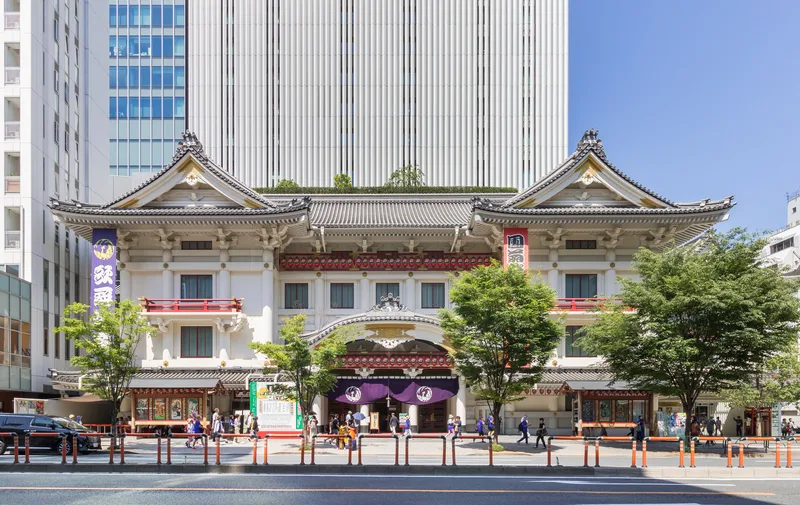 The Kabuki-za in Ginza. The house where real kabuki still happens. After Kokuhō, ticket sales at kabuki theatres climbed again. Photo: Kakidai / CC BY-SA 4.0 / Wikimedia Commons
The precision does not stop at the idea. For the roles, Yoshizawa and Ryusei Yokohama (who plays Shunsuke, the blood heir) trained for about eighteen months under Nakamura Ganjirō IV, a kabuki actor of real lineage, before a single day of shooting. This was not film choreography. It was learning the physical grammar of kabuki: the mie (the frozen pose at a dramatic peak), the control of weight, the voice, the way of moving the neck and wrists that marks the onnagata. Yoshizawa later said that, in training, he realised he would never catch up to those who had been on stage since childhood, and that what the film asked of him was not full mastery but “the spirit of clinging to kabuki even while understanding that.”
Lee reinforced that authenticity by a counterintuitive route. He hired a cinematographer who did not know kabuki: the Tunisian Sofian El Fani, of Blue Is the Warmest Colour. The choice was deliberate. Lee wanted an outsider’s eye, free of the reflexes of Japanese cinema, which tends to film kabuki in static, reverent wide shots. The result is a camera that steps onto the stage, fluid and intimate, treating the dance as bodily exertion rather than distant ceremony.
The dramatic engine of Kokuhō is a real rule of kabuki: lineage. In kabuki, artistic standing and stage names pass down the generations, father to son. Families like the Nakamura, the Onoe, the Ichikawa are dynasties. A stage name, such as Danjūrō, is inherited across centuries. When an actor takes on a great name, it is a national ceremony, the shūmei, covered like a state event.
Kikuo, the protagonist, has none of this. He is the son of a murdered yakuza boss, adopted at fourteen by a kabuki master, Hanjiro (played by Ken Watanabe). He enters the house to train alongside Shunsuke, the son by blood, the natural heir. The film spends five decades asking a single question: can the raw talent of an outsider beat the birthright of an heir?
That tension is not a screenwriting invention. It is the open wound of contemporary kabuki. Historically, the dynasties produced enough actors. In recent decades that stopped being true. According to Japan Arts Council figures cited in the press, a third of the kabuki actors working today came through the National Theatre’s training school, created precisely to make up for the shortage of heirs. And the problem has deepened: the school’s most recent two-year acting course received only two applicants. Kabuki is, quite literally, short of new blood.
The film, then, dramatises a system that needs outsiders but was built to reject them. Ichiya Kataoka, a young kabuki actor who himself entered the profession from outside, told the press the story is “strikingly modern” precisely because it shows the effort of the privileged son, Shunsuke, without turning him into a villain. There is no hero and no villain. There are two men carrying different burdens of the same system.
Making Kikuo the son of a yakuza is not a crime-genre flourish. It is the most economical way to mark, in a single stroke, just how far outside the kabuki circle he stands.
The yakuza and kabuki occupy, in the Japanese imagination, almost opposite positions within the same culture. Kabuki is sanctioned tradition, heritage, national treasure. The yakuza is the underworld, organised crime, the thing respectable society pretends not to see. To come from the yakuza is to carry the maximum stigma of social impurity into a world, kabuki, that defines itself by the purity of family transmission. The film opens in 1964 in Nagasaki with Kikuo’s father killed in a clan dispute. The orphaned fourteen-year-old carries no name, no money, no lineage. He carries the opposite of everything kabuki values. And he carries talent.
There is a further historical layer the film leaves in the background, unstated. Kabuki was itself born at the margins. It emerged in the dry riverbeds of Kyoto, was associated with sex work, was suppressed by the government. The art that is now a “national treasure” was, at its origin, as marginal as the yakuza. The film places an outsider back inside an art that has forgotten it was once an outsider too. That is the irony holding up the title: what, in the end, is a national treasure? Pure lineage, or the talent that comes from outside and renews the form?
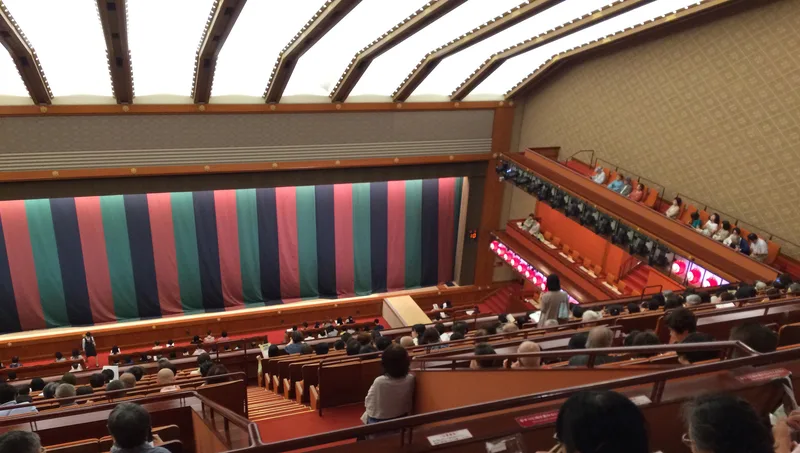 Interior seating of the Kabuki-za in Ginza — the house where real kabuki still plays. After Kokuhō, ticket sales at kabuki theatres climbed measurably. Marcinwiacek / Wikimedia Commons (CC BY-SA 4.0)
The Director Is the Answer to the Film’s Question
Lee Sang-il was born in 1974, in Niigata Prefecture, Japan. He is zainichi: an ethnic Korean born and raised in Japan, a community that has carried, for generations, an ambiguous position in Japanese society. Many zainichi adopt Japanese names to avoid social and professional discrimination. Lee kept his Korean name. In a country where a name is an immediate marker of belonging, that is a statement.
And it was this man, an outsider by origin, who directed the highest-grossing live-action film in Japanese history, about the most closed and hereditary art form in Japan. The Korean press treated this as an identity feat. Lee waved the reading off. “Don’t take it so seriously,” he said in November 2025, brushing aside questions about what it means for a zainichi director to have made the biggest Japanese film of the year.
But he conceded the connection by another, more honest route. Asked whether his own background fed his interest in the story of an outsider, he answered: “I can’t say that there’s no connection, albeit indirectly. Looking back at all my films, it seems I’m often interested in characters on the outskirts of society.” His earlier films, Villain and Rage, both adapted from novels by the same author as Kokuhō, Shuichi Yoshida, are about exactly that: people at the margins.
Lee sums up the central tension of kabuki in a line that serves the whole film and, without his saying so, his own life: “People who come from a long line of performers are born with a certain burden. But outsiders to those traditions also have their own burden.” The film picks no side. It shows both burdens, the heir’s and the outsider’s, with equal weight. It is the work of someone who knows the outsider’s burden from the inside.
In October 2025, Lee received the Akira Kurosawa Award at the Tokyo International Film Festival. In a public conversation with Yamada Yoji, the 94-year-old director and living legend of Japanese cinema, Lee called Yamada a “national treasure,” the English of the film’s title. Yamada, in turn, said that placing his own Tokyo Taxi next to Lee’s lavish kabuki drama “makes me feel embarrassed,” and that he was there to “watch and learn.” The outsider had become, himself, part of the canon.
The Film That Revived a Dying Art
The most surprising thing about Kokuhō is not its box office. It is the reverse effect. A film about an art in decline reanimated the real art.
Before Kokuhō, kabuki had been losing its audience. Attendance at the National Theatre venues, according to the Japan Arts Council, had dropped significantly and had not returned to pre-pandemic levels. Many young Japanese saw it as a closed, hierarchical, distant form. After the film, the Japanese press began reporting rising ticket sales at kabuki theatres and fresh interest among the young. A film with a lead who was not a kabuki actor, directed by a man from outside ethnic Japan, sent people back into the theatres of a four-hundred-year-old tradition.
The scale of the audience phenomenon is worth recording, because it explains why this is a special feature. Released on June 6, 2025, Kokuhō opened modestly and grew for more than a month on word of mouth, an extremely rare pattern. On November 25, 2025, it passed Bayside Shakedown 2, a 22-year-old record, to become the highest-grossing live-action Japanese film of all time domestically. By March 2026 it had cleared 20 billion yen and 12 million tickets, making it the second-highest-grossing live-action title ever shown in Japan, behind only Titanic. All of this for a three-hour drama about classical theatre that analysts had pegged as niche.
Lee, true to form, declined to celebrate too hard. “People in the Japanese industry are thrilled and excited about this hit, as it’s quite a traditional film based on a novel, but there’s no guarantee this phenomenon will continue.” It is the line of an outsider: someone who knows that belonging is never permanent, that each generation has to win its place back from zero. Which is, in the end, exactly what the film is about.
Kokuhō, the title, means national treasure. In Japan it is also a technical term: Ningen Kokuhō, Living National Treasure, the state title given to masters of traditional arts recognised as irreplaceable guardians of a form. In the film, it is what Kikuo chases his whole life: not fame, but official recognition that an outsider can be the guardian of the purest part of a tradition that was never his.
The question the film leaves, and the one the director’s own life answers, is simple. Is a national treasure defined by blood or by devotion? Kabuki says blood. Kokuhō, directed by a man who kept his Korean name in a country that rewards those who hide it, answers otherwise. The tradition survives because, every so often, someone from outside cares enough to carry it better than those born inside it.