
The Camphor Tree's Ancient Secret: Why Totoro Isn't an Imaginary Friend
Forget Western fantasy tropes. My Neighbor Totoro unpacks as a profound, Japan-first cinematic document rooted in Shinto cosmology, where forest spirits, ancient trees, and an open heart reveal a truth
When the wind stirs the trees in the Japanese countryside, rustling the leaves higher than it should, something still passes through. Children know it instinctively. Hayao Miyazaki, with characteristic grace, asks us adults to simply remember. For decades, Western audiences have embraced My Neighbor Totoro as a beautiful, heartfelt children’s fantasy, often pondering whether the titular creature is “real” or merely a figment of Mei and Satsuki’s fertile imaginations. This question, however, entirely misses the point. From a Japan-first perspective, steeped in the animistic worldview that underpins much of the nation’s cultural fabric, that question simply does not apply.
In Japan, few viewers find themselves asking if Totoro is real. This is not because the answer is self-evident, but because the rigid Western divide between the real and the imaginary, a construct inherited from Enlightenment philosophy, struggles to encapsulate the world Miyazaki brings to life. Totoro is not a metaphor. He is not a symbol of innocence, nor an allegory for grief, nor merely a poetic flight of fancy about childhood. He is kami. The colossal camphor tree he inhabits is yorishiro. The Catbus, a creature of whimsical terror, is yōkai. Even the tiny, fleeting soot sprites in the sisters’ new home are susuwatari. The entire film presents a meticulously constructed Shinto ecosystem, fully operational in the rural Japan of 1958.
Three fundamental Japanese concepts are essential to understanding this deeper reading of the film. Without them, My Neighbor Totoro appears as nothing more than a visually stunning, emotionally resonant children’s story. With them, it transforms into a powerful cultural document, revealing layers of meaning often lost in translation. These concepts are chinju no mori (鎮守の森), the sacred groves; yorishiro (依代), the vessels for kami; and kokoro (心), the receptive heart.
Chinju no mori refers to the sacred woods and forests found across Japan, meticulously preserved for generations because something resides there, or might reside there. These aren’t just patches of untouched nature; they are acknowledged, sometimes revered, spaces. Yorishiro are the physical objects that a kami may inhabit or through which it may manifest. This could be a particular rock formation, a roaring waterfall, or, most commonly, an ancient tree. A yorishiro is not the kami itself, but rather its vessel, a point of communion. Kokoro, literally meaning “heart” or “mind,” refers in this context to a state of open-hearted receptivity, an intuitive awareness that allows one to perceive the presence of kami. This quality, Miyazaki suggests, is innate in children but often diminishes with adulthood.
This Japan-first insight reveals a fascinating aspect almost entirely overlooked by Western commentary: Miyazaki’s own agnosticism. He once remarked in an interview, “In my grandparents’ time, people believed that kami existed everywhere: in trees, rivers, insects, wells. My generation does not believe that. But I like the idea that we should cherish everything because kami might exist.” This statement is critical. Miyazaki purposefully chose to build his entire film within a Shinto cosmology not because he dogmatically believed in it, but because he valued its inherent worldview. This does not weaken the spiritual reading of My Neighbor Totoro; instead, it strengthens it. It becomes a conscious authorial choice, not a cultural accident. Miyazaki, perhaps finding Western cosmological frameworks insufficient, turned to Shinto to articulate the film’s profound messages. The West asks: Is Totoro real or invented? The film, by its very nature, responds: You are asking the wrong question.
Totoro’s Tree and What a Yorishiro Actually Means
Miyazaki did not select just any tree for Totoro’s dwelling. And the film does not bother to explain why, relying instead on a shared cultural understanding. Travelers exploring Japan’s countryside still encounter these small, ancient groves amidst rice paddies. Sometimes a vermillion torii gate marks the entrance. Other times, only the sheer size and antiquity of the tree itself suggest its distinction. These are the chinju no mori, sacred groves maintained for centuries because kami reside there, or might reside there. They are natural sanctuaries, living museums of an older way of seeing the world.
Shinto tradition, unlike many Western religions, does not primarily house kami in elaborate temples. While shrines exist, the kami fundamentally inhabit specific points in the natural landscape: a cascading waterfall, an impressive rock face, a towering mountain, or a venerable tree that has stood longer than human memory. The sacred is not distant, residing in a separate metaphysical dimension; it is embedded directly into the terrain, present in the very contours of the land. It is imminent, not transcendent.
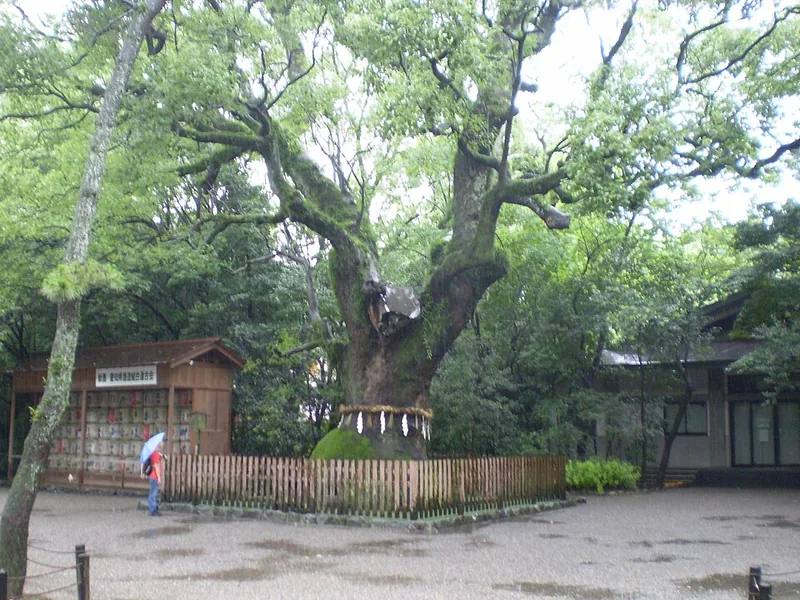 Photo: Ancient camphor tree (kusunoki) at Atsuta Shrine, Nagoya, Japan. In Shinto tradition, ancient trees like this are yorishiro: physical points where a kami’s presence may rest. Photo by Haaninjo / CC BY-SA 3.0 / Wikimedia Commons
Miyazaki deliberately placed Totoro’s home inside a colossal camphor tree, a kusunoki (楠). This choice is not merely aesthetic or decorative. Ancient camphor trees are traditional yorishiro: physical locations where a kami’s presence might dwell, rest, or pass through. The largest and most ancient of these trees often bear shimenawa, the thick, twisted straw rope that delineates the boundary between common space and sacred space. When Mei follows the smaller Totoros and tumbles into the heart of the camphor tree, she is not simply falling into a child’s fantasy. She is traversing a threshold that the film portrays with absolute gravity and respect.
The girls’ father, Kutsuki, instinctively understands this profound truth. He leads his daughters to the great tree, bows respectfully before the small Inari shrine at its base (identified by its distinctive fox statues), claps his hands twice in a traditional Shinto prayer, and politely asks the tree to watch over his daughters. This scene functions not as an explanation for the audience, but as an act of recognition. The film never explicitly states, “This tree is sacred.” It simply depicts the gesture, trusting that Japanese viewers will immediately grasp its significance. The father acknowledges that they are in the presence of something ancient and powerful, a guardian of the land.
This brings us to the concept of kokoro and the perception that often eludes adults. In Western stories about imaginary friends, the friend remains invisible to adults precisely because they do not exist; the child invents them. As the child grows, they mature, leaving behind such fantasies. In the Shinto worldview, the logic reverses. The kami are present. The adult who fails to see them has not grown up, but has instead forgotten how to perceive.
This receptive condition, this open heart and mind allowing one to recognize the presence of kami, is kokoro. Children possess this kokoro inherently. Most adults, burdened by rationalism and the demands of the material world, gradually lose it. Mei clearly has it. Satsuki, too, maintains her receptivity. Their father, while perhaps no longer seeing kami himself, does not doubt his daughters. When Mei excitedly recounts her encounter with Totoro, he does not dismiss her with mockery or condescendingly suggest it was “just a dream.” Instead, with a knowing smile, he tells her how fortunate she is: she met the guardian of the forest. He may not see Totoro directly, but he respects his child’s capacity to perceive what he has lost, treating her experience as real and significant information about their new home.
This underlying philosophy explains why Totoro never intervenes in human problems in the way a creature from Western fantasy might. He does not magically cure the girls’ ailing mother. He does not transport Satsuki to the hospital in a moment of crisis. He delivers no quests or prophecies. He simply appears, accompanies, then recedes. Kami are not saviors or problem-solvers in the human sense. They are ancient presences, part of the natural order, offering a silent form of companionship and reassurance. Their power lies in their being, not in their doing.
The same logic extends to the film’s other spiritual entities. The makkuro kurosuke: the tiny, black, dust-bunny-like spirits that Mei and Satsuki discover in their old house, are susuwatari, “wandering soot.” These are yōkai of Japanese folklore, spirits that inhabit old, unoccupied houses, manifestations of the long years of stillness and neglect. They are not menacing monsters. They simply signal that a home has been vacant long enough for the unseen world to settle in. When a family returns, the susuwatari depart on their own. They do not confront or threaten; they simply move on, continuing their unseen existence elsewhere.
And then there is the Catbus. For a Western viewer, it appears as pure invention: a giant, grinning cat with glowing yellow eyes and the impossible body of a bus. But even the Catbus has roots in Japanese tradition. It is a bakeneko: a yōkai cat from Japanese folklore, an animal that has lived long enough to cross into the supernatural. In Edo period folklore, bakeneko were often portrayed as dangerous, mischievous creatures: they could walk on two legs, mimic humans, and deceive with ill intent. Miyazaki retains the strangeness: the impossible eyes, the enormous grin, the fantastical form, but removes the malevolence. The result is a yōkai that feels both familiar and approachable to a Japanese audience: recognized from ancient stories, yet disarmed and benevolent in its new incarnation.
Three creatures, three distinct categories within Shinto and Japanese folklore: the forest kami (Totoro and his smaller kin), the yōkai cat (Catbus), and the house yōkai (the susuwatari). All operate within the same spiritual ecosystem. All are visible to those who maintain kokoro, the receptive heart. Mei possesses it. Satsuki possesses it. Most adults, tragically, do not.
The decision to set My Neighbor Totoro in 1958, rather than the film’s release year of 1988, is another layer of Miyazaki’s deliberate, Japan-first commentary. Thirty years separated the film’s narrative from its audience, and thirteen years had passed since the end of World War II. In 1958, the Tokyo Tower was under construction, and plans for the nation’s first major highways extending from the capital were just beginning to materialize. Yet, much of rural Japan still appeared as it had for centuries. The satoyama (里山): the intricate mosaic of small farms, rice paddies, irrigation canals, managed woodlands, and villages that defined the Japanese rural ecosystem, remained largely intact across most provinces. This was the Japan that kami had inhabited for a thousand years. It was a landscape where humans and nature, including its unseen inhabitants, coexisted in a delicate, balanced relationship.
By 1988, when My Neighbor Totoro premiered, very little of that satoyama remained. Rapid urbanization, the proliferation of highways, the expansion of suburbs, the ubiquitous spread of television, and the relentless modernization of daily life had transformed the country beyond recognition. The satoyama silently vanished during the decades when Japan painstakingly rebuilt itself into an economic powerhouse. By the time the film reached cinemas, the landscape it depicted already resided mostly in memory, not in the physical world. This is why the film evokes a powerful sense of nostalgia, even for Japanese audiences who never lived through that specific era. It is not merely a cute, charming reminiscence; it is an emotional document of a Japan Miyazaki watched disappear as he grew up, a heartfelt elegy for a disappearing world.
The city appears in the film primarily as the location of the hospital, where the girls’ mother is recuperating. The forest, the grandmother’s farm, the old house, the colossal tree, and Totoro himself belong to the countryside. Mei and Satsuki exist between these two worlds, navigating both the modern anxieties of the city and the timeless wisdom of the rural landscape. Perhaps it is precisely this ability to traverse that boundary (both spatial and spiritual) that allows them to perceive the kami. The satoyama depicted in the film had already largely ceased to exist when the credits rolled. Miyazaki knew this. Japan knew this. My Neighbor Totoro was a film about what was being lost, crafted by someone who still remembered it with perfect clarity.
A Sick Mother and the Fear Behind the Forest
Behind the whimsical fantasy of My Neighbor Totoro lies a personal and profound emotional core: a sick mother, a director grappling with formative loss, and a country that, in its pursuit of progress, had begun to forget. The mother’s illness in the film is not merely a dramatic device; it is a direct echo of Miyazaki’s own childhood. As a boy, Hayao Miyazaki’s mother contracted spinal tuberculosis, sekitsui kariesu (脊椎カリエス), and was hospitalized for nine years. Miyazaki, much like Mei and Satsuki, grew up with a mother who was alive but largely absent from his daily life, close in love, yet distant in physical presence. The rural hospital the family visits in the film is loosely based on the isolated sanatoriums of that era.
This personal history forms the film’s emotional bedrock. My Neighbor Totoro is not, at its heart, a story about a magical forest creature. It is a story about two young girls living with fear. Fear of losing their mother. Fear of not understanding the gravity of what the adults around them conceal. Fear of being too small in the face of an overwhelming, adult sorrow. Satsuki attempts to be strong, to shoulder the responsibilities, while Mei is still too young to process her anguish. Their father is loving and supportive, but also burdened by his own worry. The kindly grandmother offers comfort, but cannot fill the void left by their mother’s absence.
Into this emotional vacuum, Totoro appears. He does not arrive as a solution or a magical fix. He appears as companionship. Consider the iconic bus stop scene: Totoro does not promise that everything will be alright. He does not speak, does not offer comfort, does not intervene. He simply sits beside a lonely child in the rain, makes a peculiar sound, and remains present. For many Japanese viewers, this scene evokes a profound emotional response. It remains one of the most precise cinematic depictions of a child being truly seen: not saved, not consoled, but simply recognized in their existence and their need. That any filmmaker has ever captured.
So, what is Totoro? He is not imaginary. He is not a metaphor. He is not a god in the Western sense of an omnipotent, omniscient deity. He is a kami of the forest: a powerful presence intimately linked to that specific tree, that particular grove, that valley. He is not overtly powerful or necessarily interested in humans in the way humans might wish to be treated by divinities. He is simply an ancient, drowsy, partially indifferent existence, yet one capable of noticing a child when a child needs to be noticed.
Miyazaki constructed Totoro by weaving together countless layers: the chinju no mori, the yorishiro, the yōkai, the satoyama landscape, the profound experience of childhood, the specter of a mother’s illness, the loneliness of children, and the silent disappearance of a rural Japan that was already fading into memory. The resulting creature defies any simple translation or easy categorization. To call him a “spirit of the forest” feels too small, too simplistic. To call him a “god” feels too rigid, too dogmatic. To label him as mere “imagination” feels impoverished, stripping him of his true cultural weight.
Totoro is kami. And more than that: the film itself is an entire ecosystem of kami, yōkai, and yorishiro, operating precisely as they always have, visible to those who still possess kokoro, and invisible to those who have lost it. Mei has it. Satsuki has it. The majority of adults, sadly, do not.
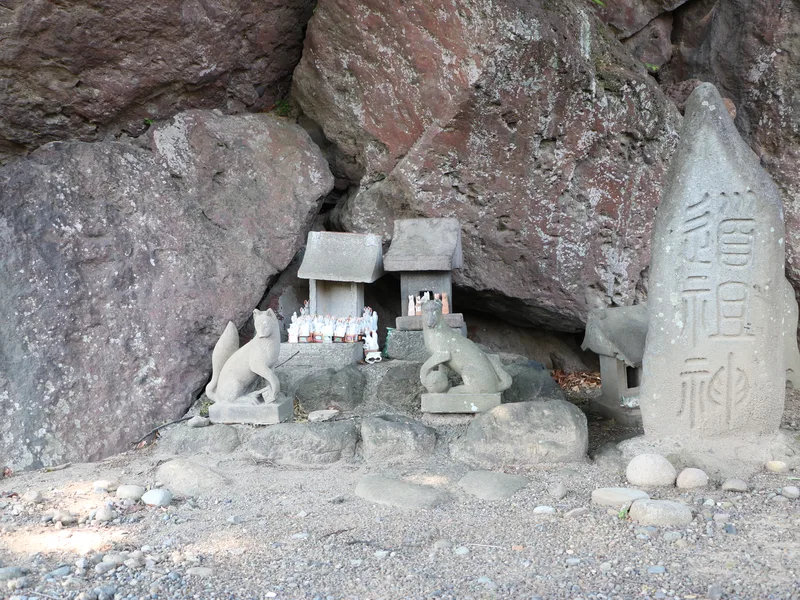 Dosojin wayside shrine with stone fox guardians and miniature hokora, sheltered under a volcanic rock, Maebashi, Gunma Prefecture, 2018. In the film, the father bows before a small Inari shrine at the camphor tree’s base — identified by exactly these stone fox figures. In Shinto cosmology, kami dwell in overlooked spaces: rocks, old trees, small shrines maintained by no one in particular. Miyazaki co-founded the Totoro no Furusato Foundation to preserve Sayama Hills (Saitama), the documented landscape model for Totoro’s rural setting. Totoro is not a Western fantasy forest spirit: he is kami in the Shinto understanding, inhabiting exactly this kind of hidden, ordinary sacred space. さかおり / Wikimedia Commons (CC BY-SA 4.0)
Yet, Master Miyazaki did not leave us without a path back. At the film’s conclusion, a strong wind whips through the trees, and the camera understands, often before we do. It is not merely the wind. It is something still passing. Even today, across the Japanese countryside, when the wind rattles the leaves louder than it should, when the branches sway with a movement that feels deliberate, something stirs there. Children know this. Adults, if they allow themselves, can remember. It is not just a gust of air. It is the Catbus, streaking by. And Totoro, in some ancient kusunoki encircled by shimenawa, waits exactly where he always has been, patiently, for someone to rediscover enough kokoro to see him once more.