
Bangkok Turned Doraemon Into Public Space
Thailand's first 100% Doraemon & Friends Tour placed 111 life-size figures and a 12-meter Doraemon beside the Chao Phraya River.
A 12-meter Doraemon appeared at the edge of the Chao Phraya River.
Around it, more than a hundred versions of the character occupied ICONSIAM, each with a different expression, pose, or gadget. Between May 1 and June 22, 2025, Bangkok hosted the first Thai edition of the 100% Doraemon & Friends Tour. Organized in collaboration with Fujiko Pro, the exposition covered more than 3,000 square meters of ICONSIAM and placed 111 life-size figures across its spaces.
The exposition came to Thailand officially for the first time in 2025. Even so, Doraemon did not arrive as a stranger. The character had been part of Thai childhoods for generations through television, dubbing, merchandise, cinema, and manga.
This created an unusual situation for an imported franchise. The audience did not need to learn who Doraemon was. It simply needed to meet him somewhere else.
111 Doraemons, a collective memory
The show brought together 111 life-size figures of Doraemon and his friends, presenting characters in both manga and animation styles. The number was striking, but repetition had a different effect.
Each figure transformed a familiar character into a different memory. For a child, discovery. For an adult, reunion. That mixture of ages matters.
Doraemon survives outside Japan because it does not depend on a single generation. Parents who knew Nobita on television can bring children who came to the franchise through streaming, cinema, or licensed products.
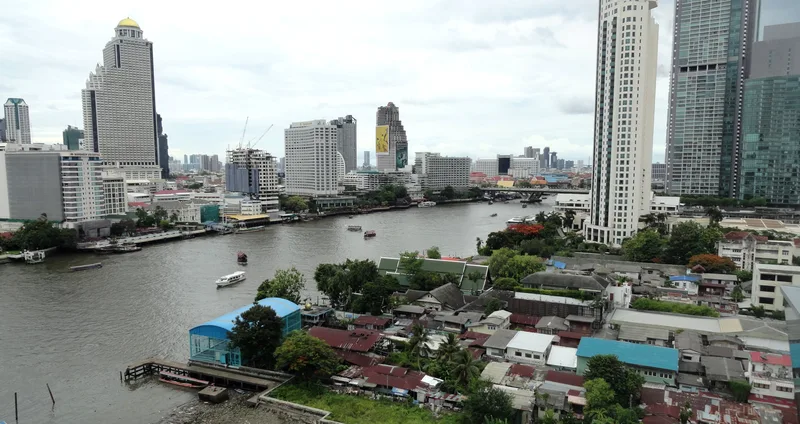 ICONSIAM and the Bangkok skyline, seen from the mall’s sixth-floor open terrace. Fabio Achilli / Wikimedia Commons (CC BY 2.0)
Part of the exposition occupied the River Park at ICONSIAM, a separate ticketed zone with its own 199-baht entrance. More than 90 figures were placed across that riverfront section. The giant inflatable Doraemon, measuring over 12 meters, stood at the edge of the Chao Phraya, directly visible from the river.
Moving part of the exhibition outdoors placed Doraemon alongside Bangkok’s open sky and the water the city was built around. When a franchise occupies that kind of space, it stops speaking only to dedicated fans. For the weeks of the tour, it became part of the city’s visible landscape.
The tour unveiled the 100% Friends-Calling Bell in Thailand for the first time. It is a symbolic item built around the exhibition’s theme of friendship, and it had not been presented in earlier stops. The Thai edition was not a neutral repeat of the previous format. The Bell is the one element of the experience shaped for this specific stop.
Why Doraemon works in Thailand
Doraemon is Japanese in its routines, but simple in its conflict. Nobita wants to avoid duties, escape problems, impress friends, and correct mistakes without effort. The gadgets seem futuristic. The emotions are domestic.
That combination travels well because it does not require the audience to know Japan deeply. Family, school, friendship, and embarrassment are already understandable. Japanese culture appears inside a childhood that Thai audiences can recognize.
The exposition included exclusive merchandise, ticketed zones, and attractions designed for photography. It would be easy to reduce everything to consumption. But cultural impact does not disappear because commerce exists.
Products are one of the ways a franchise fixes itself into daily life. A shirt, a figure, or a travel souvenir extends the experience after the exposition ends. The question is whether the audience participates only as a buyer, or whether it also converts the character into local memory. In Bangkok, both things appeared to happen at the same time.
Japan created Doraemon. Thailand decided what to do with it after decades of living together.
In 2025, that relationship took a physical form: 111 characters, a blue giant measuring over 12 meters, and families gathered at the edge of a Thai river. That image explains the international strength of the franchise better than any ranking. Doraemon was not simply visiting Bangkok. For a few weeks, Bangkok opened space for it inside its own landscape.
The same kind of exchange has played out elsewhere in Southeast Asia. In Vietnam, the Detective Conan franchise earned the world premiere of its 30th anniversary exhibition. In the Philippines, Voltes V survived a government ban and eventually returned to Japan as an officially licensed live-action series. The pattern in each case was the same: Japan produced the work, and local audiences decided how much of it to keep.
The first Thai Doraemon exposition did not only prove that the franchise still sells. It showed that a Japanese character can cross decades, languages, and generations until it stops feeling imported.
That is the moment when fandom becomes something else. Not when the audience recognizes the character. But when the city finds a place for it.
Tomodachi Project · Single-country editorial, Thailand focus. Factual sources: The BigChilli press release (April 30, 2025), Nation Thailand, 100% Doraemon & Friends Tour official site (doraemon100.com), Bangkok Metropolitan Administration festival calendar. Interpretive observations are editorial.