
Vietnam Was the First Country Outside Japan to Host the Conan Exhibition. Aoyama Said Thank You With a Painting.
In June 2024, Ho Chi Minh City became the first city in the world to host the Detective Conan 30th Anniversary Exhibition outside Japan. Gosho Aoyama drew an original painting specifically for Vietnamese fans.
On July 25, 2025, Detective Conan: One-Eyed Flashback opened wide across Vietnam on the CGV, Lotte, and Galaxy circuits. Before the general release, Vietnamese theaters had already sold more than 500,000 tickets and reported roughly 48 billion dong in revenue. Within days, the total crossed 100 billion. The week’s second-highest earner, The Smurfs, made 4.4 billion. Superman took 3.48 billion.
For Western box office trackers, that number is background noise — another Japanese film doing well in Asia. For Shogakukan, Gosho Aoyama’s publisher for more than thirty years, it is not. It confirms something the publisher had already made explicit the year before, in an official decision: Vietnam had become one of the most important markets for Detective Conan outside Japan.
On June 25, 2024, the Vietnam News Agency announced that Shogakukan, together with Japanese production company Jazzy Paradise and Vietnamese publisher Kim Đồng, had chosen Ho Chi Minh City to host the international premiere of the Detective Conan 30th Anniversary Exhibition. Vietnam would be the first country in the world to receive the exhibition outside Japan.
The timing was deliberate. The exhibition had run in Tokyo from January through February 2024, in Sapporo in April and May, in Sendai in May and June. On June 29, before several Japanese cities still on the schedule and ahead of any other Asian stop, it opened at the Gigamall Shopping Center in Thu Duc, Ho Chi Minh City. It ran through August 31, then moved to the Kim Đồng headquarters in Hanoi, where it ran from October 26 through December 25.
Inside that exhibition was a detail most Western fans did not hear about. Gosho Aoyama — a private artist who rarely addresses audiences outside Japan directly — drew a painting specifically for the Vietnamese premiere. Local press described it as a gesture of greeting and gratitude to Conan fans in Vietnam. The piece was unique to that two-month run in Thu Duc. It had not been made for Tokyo, Sapporo, or Sendai. It was made for this. The exhibition’s key visual was also drawn personally by Aoyama — an original illustration, according to the Vietnam News Agency.
Kim Đồng published the first Vietnamese volume of Detective Conan on April 21, 2000. The initial twenty-five volumes came out weekly or biweekly, racing to catch up with Japanese releases that had begun in January 1994. From 2009, the publisher shifted to a “100% Japanese” format — right-to-left reading, no mirroring, original onomatopoeia preserved. By August 2024, Kim Đồng had reached volume 102 in Vietnam; Shogakukan was on volume 108 in Japan, a gap of only a few months.
In Vietnam, the series became one of Kim Đồng’s strongest editorial properties. In 2020, according to figures reported by Shogakukan, volumes 93 through 96 each sold more than 1.5 million digital copies in the Vietnamese market alone — figures that rival the circulation of many adult literary bestsellers in the country.
Kim Đồng also published spinoffs that most international markets never receive in sequence: 44 volumes of the Detective Conan Special, 9 novels, 4 volumes of Magic Kaito, plus Ani-manga, Super Digest Book, FBI Collection, Romance Collections, Secret Files. This is an editorial ecosystem. In Vietnam, Conan is not a product. It is a category.
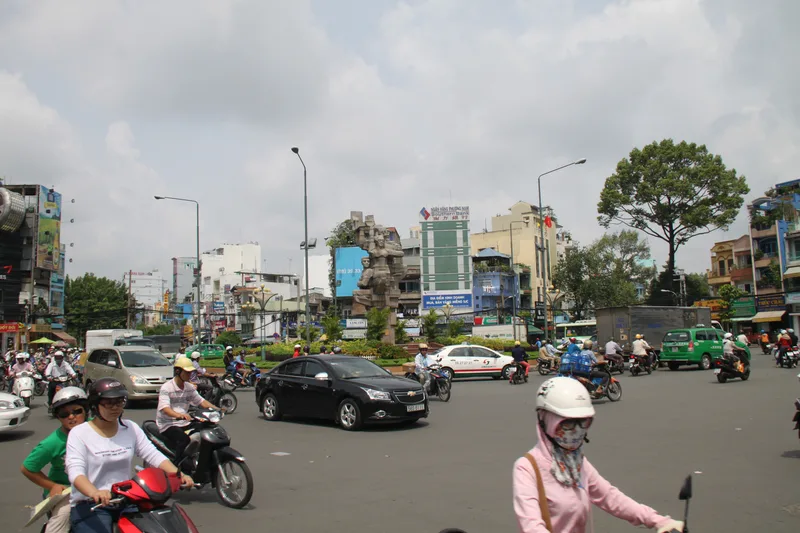 Street scene in Cholon, Ho Chi Minh City, 2013. In a city of this scale and density, Detective Conan ran for twenty-five years before the publisher decided it had earned the right to host the world premiere of the 30th anniversary exhibition. Gary Todd / Wikimedia Commons (CC0)
Why Vietnam, not China or South Korea?
China has a far larger population. South Korea has a more established manga publishing industry. Taiwan has decades of Shogakukan manga coverage. Why did the international premiere of the thirty-year anniversary exhibition go to Ho Chi Minh?
Three hypotheses hold up against the data. First: Vietnam is one of the markets where Detective Conan stopped being a simple import and became a broad editorial line. Doraemon still leads in popular memory, but Conan sustains paid, continuous product at Kim Đồng — not just nostalgia. Second: Ho Chi Minh City and Hanoi developed regular manga and anime events where Detective Conan appears as a consistent presence in cosplay and merchandise. Third, and most significant: Shogakukan placed its soft power bet where the growth curve was visible, not where the audience was already saturated. China and South Korea are mature Conan markets. Vietnam is an expanding one.
The same pattern appeared with Doraemon in the 1990s and with Voltes V in the Philippines in the 1970s: Japan offered a cultural product, and Southeast Asia decided how much to buy, remember, and convert into long-term habit. In 2024, Shogakukan acknowledged — with the bureaucratic precision a Japanese press release allows — that Vietnam’s response was strong enough to earn the global premiere.
When One-Eyed Flashback opened in Vietnam in July 2025, it had already earned more than 14 billion yen in Japan — the third consecutive Conan film to cross the 10-billion-yen mark. The Vietnamese record — over 100 billion dong in days — places the country among the franchise’s strongest international markets. Earlier films had already pointed in this direction: Movie 25, Halloween Bride, made 58 billion dong in Vietnam in 2022; Movie 27, The Million-Dollar Pentagram, took in roughly US$4.8 million in 2024.
The anime itself, dubbed in Vietnamese by HTV3 since December 2009 and later distributed across local platforms, confirms that Conan does not exist in Vietnam only as an event film. It circulates as a long-term habit.
What this means for Japan
Japan tends to frame Cool Japan as a top-down export. Detective Conan in Vietnam tells a different story: twenty-five years of consistent local readership helped convince Shogakukan to make the international premiere of the thirty-year anniversary exhibition a Vietnamese decision, not a home market one. The painting Aoyama made for Ho Chi Minh City in 2024 is, in the scale of Japanese editorial gestures, equivalent to a public declaration of gratitude — an acknowledgment that one of the readers who sustained the work was somewhere else.
When the next film arrives in 2026, it will not be a surprise if Ho Chi Minh is ready almost as fast as Tokyo, with a translation, a campaign, and a mobilized audience already in place. That is not a bold prediction. It is the pattern that has been forming for years while almost no one outside Asia was paying much attention. Vietnam is the Conan reader Japan took too long to see.
Tomodachi Project · Single-country editorial, Vietnam focus. Box office data cited from Vietnamese sources (vietnamnet.vn, hobiverse.com.vn). Editorial data via Shogakukan/Kim Đồng. Interpretive observations are editorial.