
Jakarta Did Not Watch One Piece. It Ran as a Crew
Thousands turned a 5K race into Indonesia's first One Piece Run. The most revealing detail was not on the podium, but in who decided to run alongside the fans.
At five in the morning on June 7, Jakarta started filling with people in straw hats, bandanas and crew shirts. They were not heading to a convention. They went to Epiwalk Lifestyle, in the Kuningan district, to run five kilometres as if the finish line were one more island on the Grand Line.
The One Piece Run Indonesia drew thousands to the first Indonesian edition of a format that had already passed through other Southeast Asian markets. It was official and licensed, organised as a physical experience of the franchise: race pack, race bib, themed medal, interactive photo spots, and runners turning characters into workout clothes. It also shared the morning with the Rasuna Said Car Free Day, which meant the race did not feel like a closed ticketed event dropped into the city. It felt like a community festival the city was already having.
The most revealing detail came from an unlikely presence. Ritsuo Fukadai, president-director of J Trust Bank Indonesia, did not show up only to hand over a cheque or pose in front of the sponsor wall. He finished the race alongside the participants. A Japanese executive at an Indonesian bank ran among local fans of a Japanese manga. The image captures the cultural circulation of One Piece in Indonesia better than any corporate statement.
When “nakama” stops being a subtitle
In Japanese, nakama (仲間) is someone who belongs to the same group, team or circle of trust. One Piece turned the word into a global emotional promise. At the Jakarta race, it stopped being a translated subtitle and became a method of taking part.
Registration did not just sell access to a route. The basic pack carried a T-shirt, a drawstring bag and a race bib; the premium tier added a hat, a poster and socks, with optional add-ons like a pin set and a tumbler. The fan did not need to play Luffy on a stage. It was enough to cross the city with friends and accept that the body was part of the game.
That shift matters. For decades, the presence of anime outside Japan was measured by ratings, VHS sales, dubbing, box office or convention size. The One Piece Run measures something else: how many people will reorganise a Sunday morning to live the work collectively, in public space.
After the route, runners did not just go home. They moved into the Epiwalk stage area for Body Combat sessions, fun games and themed merchandise booths through the morning, which turned the finish line into the start of a community festival rather than the end of a race.
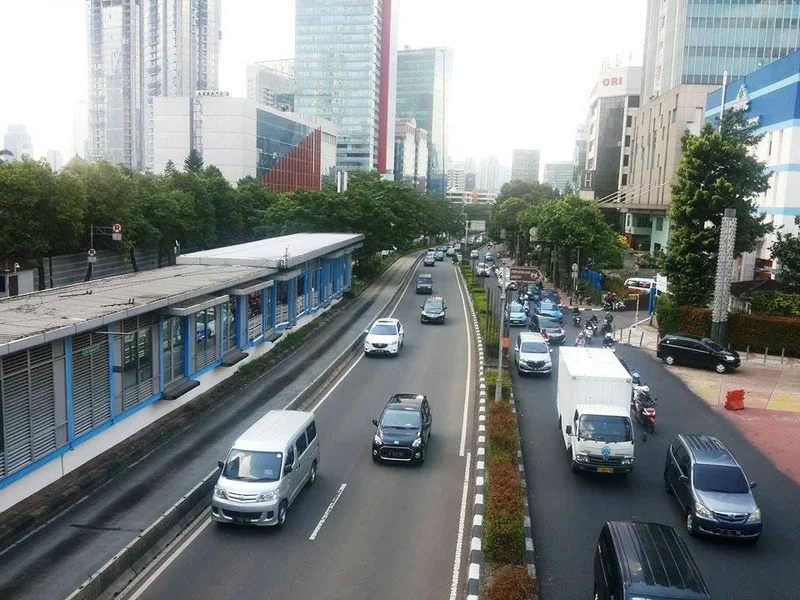 Jalan H R Rasuna Said, Jakarta’s Kuningan district. The boulevard that serves as the Car Free Day route and gave the One Piece Run its path through the city. M R Karim Reza / Wikimedia Commons (CC BY-SA 4.0)
A Japanese franchise tuned to Jakarta’s rhythm
The event also shows how a Japanese property scales when it passes through local operators. It was a collaboration between Provaliant Sports, Epiwalk Lifestyle, Springboard and Toei Animation, with tickets sold through Loket, the ticketing platform Indonesians already use. J Trust Bank took the banking-partner slot and ran activations on three weekends before the race. That chain looks commercial, and it is. But it explains why the experience did not read like a copy shipped from Tokyo. The race was fitted into a Jakarta mall, sold in rupiah, promoted by local accounts and turned into a family programme.
Eiichiro Oda’s universe arrived with its symbols, but it had to learn to move through Indonesia’s urban and digital infrastructure. The licensing is what makes the event and its merchandise official. The run is licensed by Toei Animation and Shueisha, the same companies behind One Piece, which means every design, from the medal to the race bib, is official rather than bootleg. The cheapest entry had been announced from Rp 399,000. This was not an informal fan meetup. It was an official product with a price barrier, its own merchandise and sponsors. Thousands still showed up.
There is something very One Piece about that. The series has always treated movement as a bond. The crew forms by travelling, not by talking about travelling. In Jakarta, the participants did not need to cross oceans. Five kilometres were enough to turn separate viewers into a crowd that crossed the same line.
Anime reached Indonesia through television. The manga grew in bookshops, illegal scans, official editions and social media. Now part of that fandom wants to occupy streets, malls and sports calendars. When a bank president runs next to cosplayers and families, the franchise stops being merely imported content. It becomes a local language for doing things together.
Tomodachi Project · Scheduled editorial. Facts based on published reports. Interpretive observations are editorial.