
Special: Nausicaä — Part 1: The Messiah in Blue
The 1984 film that launched Studio Ghibli did not exist yet when it was made. Nausicaä of the Valley of the Wind opened on March 11, 1984 — and changed everything that came after.
Studio Ghibli did not exist when the film that created it was made. Nausicaa of the Valley of the Wind opened in Japan on March 11, 1984, and almost everything Hayao Miyazaki built afterward grew out of it. It is the first time a Japanese audience saw Nausicaa move on screen. It is also the last time Miyazaki would let this character end by consoling anyone.
Before Ghibli Existed
The film was not born inside Studio Ghibli, because Studio Ghibli did not yet exist. Tokuma Shoten, the publisher whose magazine Animage was serializing Miyazaki’s manga, had no animation studio of its own. Miyazaki and Isao Takahata (reluctantly, in the version Toshio Suzuki would later tell) chose Topcraft, a small studio that had survived on subcontract work for the American Rankin/Bass, the company behind the animated The Hobbit and The Last Unicorn.
The money came from an unlikely arrangement. Tokuma put up half. The other half came from Hakuhodo, the second-largest advertising agency in Japan, after its president was personally convinced by Yasuyoshi Tokuma. Toei agreed to distribute but did not believe in the project, and tried to cut the marketing budget. Tokuma went in person to convince the Toei president to keep the funding.
The score went to a 33-year-old composer who signed as Joe Hisaishi, real name Mamoru Fujisawa, then just starting out. It was the first time he and Miyazaki worked together. Hisaishi would score every Miyazaki film that followed, for four decades. The film opened on a double bill, paired with a compilation of two Sherlock Hound episodes, also directed by Miyazaki.
The Princess Was a Scientist Before She Was a Saint
The film opens on a legend. A valley protected by a sea wind that drives off the spores. A toxic forest called the Fukai (腐海, “Sea of Corruption”). Giant insects called Ohmu (王蟲) whose eyes shift from blue when calm to red when enraged and back to blue, a gradient that works as the film’s internal signage. Nausicaa, princess of the valley, is the one who listens: to the wind, to the fear of her own people, to the pain of the Ohmu.
Her name carries two inheritances. The first is Greek. Nausicaa is the princess in Book VI of the Odyssey, daughter of King Alcinous, who receives the shipwrecked Odysseus on a beach and treats him as a guest without knowing who he is. Miyazaki read Homer as a teenager. The second is Japanese. Mushi Mezuru Himegimi (虫めづる姫君), “The Princess Who Loved Insects,” is a tale from the twelfth-century Tsutsumi Chunagon Monogatari, about a young aristocrat who refuses court protocol to study caterpillars and butterflies. Miyazaki crossed the two figures: the radical hospitality of the Greek, the stubborn zoological attention of the Japanese.
The break from the dominant Western fantasy of the period is not decorative. The classic princess of that era waited to be chosen. The Miyazaki princess walks into the poisoned forest because no one else will. She touches what no one touches. We meet her first at an improvised laboratory, examining spores under a microscope she built herself. Before she is a princess, she is a field scientist.
 Tonen General petroleum refinery, Kawasaki-ku, Keihin Industrial Zone, Tokyo Bay, 2014. The same postwar industrial build-up that filled this stretch of Tokyo Bay with refineries, steel mills, and chemical plants produced the pollution crisis Miyazaki was drawing on in Nausicaä. Japan’s Big Four pollution diseases — Minamata, Itai-itai, Yokkaichi asthma, Niigata Minamata — all emerged from this era. The world before the Sea of Corruption was not invented: it was observed. FoxyStranger Kawasaki / Wikimedia Commons (CC BY-SA 3.0)
Her laboratory matters more than it looks. In a hidden chamber under the castle, Nausicaa grows Fukai saplings in clean water and clean soil drawn from deep underground, and finds that, away from the soil the old civilization poisoned, the toxic plants grow without producing poison. The forest is toxic because the soil it is trying to filter is toxic. The revelation is methodological, not mystical. She does not reach it through feminine intuition or a generic love of nature, the two Western cliches about Miyazaki heroines. She reaches it through observation, hypothesis, and experiment. Before the messiah, the researcher. Before the saint, the botanist.
That poisoned, still-living land has a real origin. Across the 1950s and 1960s, the Chisso Corporation (チッソ) discharged methylmercury into Minamata Bay, in Kumamoto, poisoning a fishing community for two decades. Miyazaki has named that image, a land that kept living while it was being poisoned, as one of the documented seeds of the Sea of Corruption.
Another thing the film establishes with economy: Nausicaa flies. She rides the wind on a single-seat glider called the Mowe (German for “gull”), handling it like an extension of her body. Anyone who has watched Miyazaki draw wind across his career, in Porco Rosso, in Mononoke, in Ponyo, recognizes here the first full statement of that obsession. Wind in this film is not setting. It is character. It is what separates the Valley of the Wind from the Fukai, what carries Nausicaa, what signals through a change of direction that the world is about to shift. Topcraft animated wind with no equal at the time: layers of particles, foliage in waves, capes in flow. Miyazaki has never since trusted anyone to draw wind without revising it himself.
The conflict arrives fast. Tolmekia, an imperial military power, invades the Valley of the Wind. Princess-general Kushana brings with her a terror kept in embryo: the Kyoshinhei (巨神兵, “Giant God-Warrior”), a biotechnological weapon of the lost civilization, the same kind that burned the world in the Seven Days of Fire a thousand years earlier. Unstable. Half-awake. Able to burn the world again if it ever finishes being born.
Kushana is not a generic villain, and the film says so in almost no space. She wears full armor because, in a single line of dialogue, the film reveals that the insects of the Fukai ate part of her body. The armor hides prosthetics. When she speaks of the Ohmu there is personal hatred under the imperial logic. She does not despise Nausicaa. She recognizes her. There is an almost reluctant respect when the two meet, the kind generals reserve for other generals. The manga will spend seven volumes on this. The film plants it in three shots.
On screen the Kyoshinhei is pure horror. A rotting carcass trying to obey a command. The mouth opens like a wound. The skin melts before it fires, and when it fires, it fires badly, and fails. Monster and pathetic at once. The absolute weapon of the lost civilization is, on screen, an abortion, and Miyazaki does not hide his contempt for it.
When Nausicaa Opens Her Arms
The heart of the film does not beat there. It beats in the baby Ohmu scene.
Pejite, a rival city-state, captures a wounded juvenile Ohmu and uses it as bait to pull the adult herd toward Tolmekia. The creature bleeds. It tries to return to its kind. The humans look at it and see a tool of war.
Nausicaa looks at it and sees a wounded child.
That is the turn. Until that moment a viewer could still read the Ohmu as a threat. In front of the juvenile, the frame inverts: the monster feels pain too. When the herd finally advances, red and enormous, it does not look like an army of animals. It looks like the planet itself moving.
Then Nausicaa makes the gesture that defines the film. She does not fight. She does not kill. She returns the young one. She opens her arms, accepts the impact, falls, and appears to die. The Ohmu lift her with their golden tentacles, which by the film’s own visual rule heal, and the blue princess walks across the golden sea of tentacles like a religious figure the film does not even pretend to disguise.
The music earns its own attention. Hisaishi wrote a choral arrangement for soprano and orchestra that borrows, without quoting literally, the vocabulary of a Catholic requiem. Heard with eyes closed, Nausicaa’s main theme could pass for an early twentieth-century funeral mass. In a film of Japanese ecological fantasy, Hisaishi and Miyazaki deliberately import the sound of Western religious redemption into the scene where Nausicaa returns from the dead. It is not cynicism. It is authorship.
This matters for Part 2. The iconography of the closing scene is not subtle. Nausicaa extends her arms, is lifted, walks in golden light over a collective mass. It is not a metaphor for resurrection. It is the image of resurrection. The film is neither Christian nor Buddhist. It quotes the visual vocabulary of redemption through sacrifice because, in 1984, the vocabulary still worked.
The Ending as Consolation
So the film ends as consolation. The Valley of the Wind survives. The Ohmu retreat. The prophecy is fulfilled. The people who left the theater were the ones who believed purity could save the world, and the ones who wanted to believe it.
The film opened the commercial path Miyazaki needed. Tokuma made money. Topcraft went bankrupt a year later, in June 1985. On the same day, Hayao Miyazaki, Isao Takahata, and Toshio Suzuki took over its assets and founded Studio Ghibli. Toru Hara, who had founded the bankrupt Topcraft, became the new studio’s first manager. Nausicaa is, then, the pre-Ghibli film that made Ghibli possible.
A crack is already visible in 1984, if the viewer slows down. The Fukai stays intact. Human division stays. Weapons stay desired. The past stays unexplained. The film ends just before the harder question. It shows Nausicaa as a messiah and never asks whether the world needs one. It shows the Kyoshinhei as a monster and never explains where it came from. It delivers a nearly happy ending and closes the program before anyone can ask why the nearly.
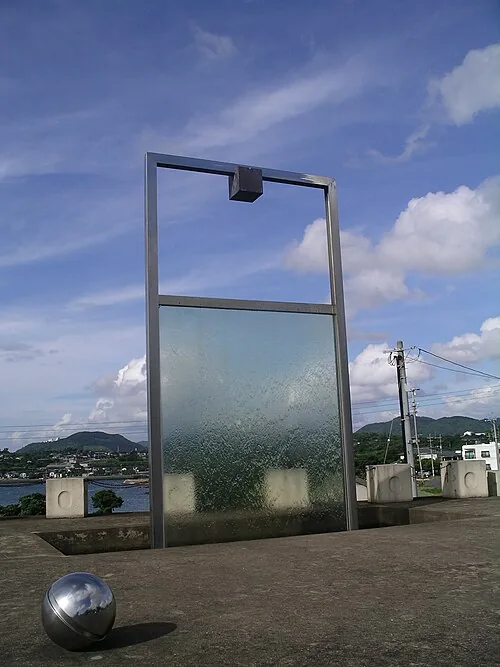 Minamata Memorial, Kumamoto, Japan. The mercury contamination of Minamata Bay in the 1950s-60s, caused by Chisso Corporation’s industrial discharge, poisoned a fishing community for two decades. Miyazaki cited this environmental disaster as one of the documented origins of the Sea of Corruption in Nausicaä. Bobo12345 / Wikimedia Commons (Public Domain)
Miyazaki knew this better than any viewer. The film covers, with changes, only the opening stretch of a manga he had already been drawing for two years. The story would run another decade in another medium, and in another moral direction.
In 1985 a recut American version circulated in the United States as Warriors of the Wind, with about twenty minutes removed, added narration, reshuffled subplots, and renamed characters (Nausicaa became Princess Zandra). The posters showed male warriors who are not in the film. Miyazaki was furious, and Ghibli’s later no-edits policy for foreign licensing was born from it. Years later, when Miramax pushed to cut Princess Mononoke, a Ghibli producer reportedly answered with a katana placed on the table and a single line: “No cuts.”
But in 1984, still inside the story, the Valley of the Wind sleeps in peace. Miyazaki hands the audience something he will take back slowly, chapter by chapter, over the following decade.
This is Part 1 of 2. → Continue to Part 2: The Manga That Destroys the Film’s Paradise