
Special: Nausicaä — Part 2: The Manga That Destroys the Film's Paradise
The seven-volume manga that Miyazaki drew over twelve years tells a different story than the film — and ends in a place the film could never go.
This is Part 2 of 2. ← Read Part 1: The Messiah in Blue
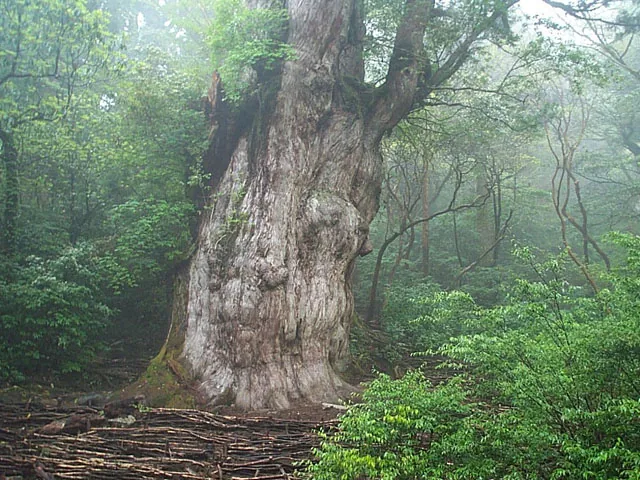 Photo: Jōmon Sugi cedar, Yakushima — the oldest known living tree in Japan, estimated at 2,000–7,000 years old. In the manga’s world-view, living things of this age are not background: they are testimony. Photo by Yosemite / CC BY-SA 3.0 / Wikimedia Commons
Miyazaki drew the Nausicaa manga for Tokuma Shoten’s magazine Animage between February 1982 and March 1994. The seventh and final volume came out in early 1995. The complete work runs to roughly a thousand pages, broken by long interruptions, because Miyazaki kept leaving it to direct Laputa (1986), Totoro (1988), Kiki (1989), and Porco Rosso (1992), with Mononoke waiting on the other side. It is the longest work of his career, and the only one in which he had the time, in a single medium, to rewrite his own conclusion.
The origin of the work is itself counterintuitive. Around 1980, after the modest box office of The Castle of Cagliostro (1979), Miyazaki kept pitching film projects and kept being turned down. Hideo Ogata, editor-in-chief of Animage, and Yasuyoshi Tokuma offered a side door: do the manga first, publish it monthly, and if it catches on, make the film. Miyazaki agreed on one condition. No anime adaptation. He drew the manga, as he later put it, to say things animation could not carry.
That was the stated reason. The real one was that he wanted narrative space at scale. Animation chains the author to the calendar, the budget, the two-hour limit. The manga does not. The manga lets the author think.
Three months after closing the last chapter, in a 1994 interview, Miyazaki said that once he started taking the story seriously in the manga, he found there was so much he did not understand, and that he wrote it from beginning to end carrying a great deal he never resolved. It is among the most honest things he has said about his own work. And it is the exact point where the manga and the film stop being two versions of the same story.
The manga became Animage’s most popular feature almost at once, and yet Miyazaki tried to abandon it several times across the twelve years. In a 1995 interview with Ryo Saitani he recalls asking Ogata to let him stop, and the editor talking him out of it. The interruptions show in the rhythm of the work. Volume one runs across 1982 and 1983. A pause during Laputa. Volume two closes in 1986. Another pause through Totoro and Kiki. Volume four only appears in 1991, the year Japan’s asset bubble burst. The writing of the ending, volumes five through seven, runs through the exact period when Japan was realizing the golden decade was over.
This matters for reading the manga. Miyazaki is drawing the collapse of an industrial civilization while the industrial civilization around him takes itself apart, in slow motion, dismantling the confidence of 1985.
The graphic style sets the manga apart from almost all commercial manga. Miyazaki draws in pencil, without ink, on large paper, in dense panels where the background swallows the foreground. The critic Kentaro Takekuma noted that, especially early on, it is hard to tell characters from setting without effort. A reader trained on clean lines and clear separation has to slow down. The manga is physically slow to read, the opposite of the kinetic film.
The first two volumes match the film, with changes. From volume three on, the world expands past anything two hours of cinema could hold. Tolmekia and Dorok appear as full civilizations, with religion, politics, geography, collective neurosis. Kushana gets a biography: a mother driven mad by poison at court, rival brothers, family tragedy. Kurotowa, a footnote in the film, becomes one of the sharpest minds in the manga, cynical in the old Greek sense, capable of an ambiguous loyalty to Kushana precisely because he reads court politics better than she does. Yupa carries the weight of someone who has seen too much. Asbel and Selm fill the space around Nausicaa so she stops being the only moral axis of the work.
She is still the center. But across seven volumes she learns that no single truth belongs to one person, and that the disease of her world is not violence. It is the belief that someone always has the right to decide who deserves to live.
The Fukai Was Never a Curse. It Was a Design.
The great revelation lands in volume seven, at the Shuwa no Bosho (シュワの墓所, “the Crypt of Shuwa”). The Fukai is not an environmental curse. It is a biotechnological filter. The fungi, the spores, the Ohmu, all of it belongs to an artificial system the old civilization designed to purify the Earth over thousands of years.
For most fiction that would be turn enough. Miyazaki turns again.
The humans of Nausicaa’s world, herself included, are not humans in the old pre-apocalyptic sense. They were genetically edited to breathe the poisoned air. They belong to the wounded Earth. When the planet finishes cleaning itself, the old air will return, and they will not be able to breathe it.
The promised paradise, in other words, was never built for them.
The Crypt of Shuwa holds the rest: embryos of a “correct” humanity, kept in stasis by the ancients, set to wake when the air is clean enough. Everyone alive now, Nausicaa, her people, the Dorok, the Tolmekians, is a transitional stage. They exist to cross the contaminated centuries. In the plan of the ancients, they are disposable, with a scheduled expiry.
Here Miyazaki delivers the blow that separates the manga from almost all Western ecological fiction. The plan is technically coherent. Save the Earth. Restore the air. Preserve a clean humanity. Remove the poison. From outside, it looks virtuous. From inside, it is extermination written in the language of gardening.
A Japanese reader in 1994 understood the reference without explanation. The plan of the ancients is the mental shape of any twentieth-century utopia that bought the idea of purifying in order to save. Swap the word ancients for modern social engineering, eugenics, population planning, environmental fundamentalism, and the structure holds. Who gets left off the paradise spreadsheet?
Nausicaa understands. She refuses. She destroys the Crypt of Shuwa.
It is Miyazaki’s hardest authorial gesture. She has no plan B. No new religion. No guarantee her people will survive. No confidence that history will judge her kindly. She has only one thing: the refusal to accept that any future has the right to erase the life that already exists.
The Kyoshinhei of the manga is no longer the pathetic monster of the film. It is given a name, Ohma, by Nausicaa, a childlike voice, and something close to a newly woken consciousness that looks at its human mother before it understands what it is. There is something of a son in it. Something of a bomb that has not gone off and may not want to. Miyazaki will not let the reader hate it cleanly. The monster is also the orphan of a dead civilization.
Reading the Kyoshinhei as an image of the atomic bomb is defensible, and that reading has run through Japanese criticism since the 1990s. Miyazaki was born in 1941. He grew up inside the visual culture of the mushroom cloud as the century’s original sin. The Ohma carries it: from far away it looks like the decisive weapon, up close it burns whoever tries to use it. And it does not only burn bodies. It burns morality, compassion, the ability to see the other as life. When, in volume six, Nausicaa walks beside an Ohma already sick and decomposing on schedule, the panel does not ask for pity for the weapon. It asks the reader to see that every absolute weapon is also an orphan.
The Offer, the Refusal, and the Sentence Against Every Utopia
When Nausicaa enters the Crypt of Shuwa beside the Ohma, in volume seven, the scene moves less like a manga fight and more like a slow requiem. The master of the crypt, a hologram speaking for the will of the ancients, makes the offer: accept the plan, preserve the archive, let the purified Earth receive those who were prepared for it. The offer is rational. It is beautiful. It comes with moral cover.
Nausicaa refuses in one sentence, rendered in the VIZ Media edition as: “Suffering and tragedy and folly will not disappear in a purified world. They are part of humanity.”
It is not a line of ecological fantasy. It is a line against every modern utopia.
In the film, Nausicaa saves by sacrificing herself. In the manga, she saves by agreeing to carry a guilt. The two are not the same. The first is redemption fantasy. The second is ethics without a guarantee.
This is where the manga stops being an ecological fable and becomes something larger. Miyazaki is talking about twentieth-century humanity. About science without a soul. About the bomb. About the bureaucratic temptation to build perfect systems by spending real people. About the arrogance of those who read the future as a spreadsheet and forget that life never fit in one.
The manga’s question is not how to save the world. It is who gets left outside the world that was saved.
Nausicaa understands that the answer is unbearable. She refuses the paradise of the ancients. She refuses the purified humanity. She refuses the future planned by the dead. She refuses a salvation that runs on disposal.
There is no final wedding. No restored kingdom. No villain cleanly beaten. No music telling you it ended well. There is a girl standing under the weight of the world, choosing to go on. Without heaven. Inside hell. Without a guarantee.
In 1994, the year the last chapter ran, the manga won the Grand Prize of the Japan Cartoonists Association Award (大賞), given by a jury of working cartoonists. That is recognition from peers, not from the public. Miyazaki’s colleagues understood that what he had done in the manga was different from what he had done in the film, and they honored the manga on its own. The film had already taken its prizes in 1984. The manga had to earn its own.
Princess Mononoke, three years later in 1997, is Miyazaki’s attempt to bring to the screen part of what he had understood in the manga. Moro, the giant wolf, does what the Ohmu would do: kill without malice, and be respected anyway. San and Ashitaka get no messianism, only continuation. Some call Mononoke the spiritual sequel to the Nausicaa manga. It is more than that. It is Miyazaki trying, in the same cinematic format that had offered consolation in 1984, to refuse the consolation he himself had made.
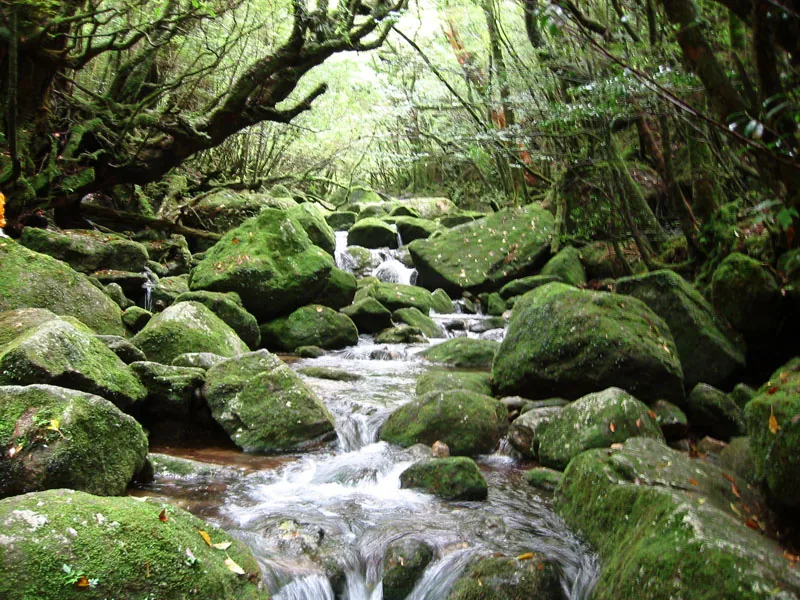 Photo: Shiratani Unsuikyo gorge, Yakushima — forest, water and rock in uninterrupted coexistence. The ecology the manga defends is not a paradise to be restored; it is a process, ongoing, wounded, and irreplaceable. Photo by Yosemite / CC BY-SA 3.0 / Wikimedia Commons
This is Part 2 of 2. ← Back to Part 1: The Messiah in Blue